In winter we spend almost all our time indoors with the windows closed. Ventilation removes CO₂ and humidity, while...

Latest posts
-
 Closed windows in winter: ventilation and air purifier, the right pair for your indoor airRead more: Closed windows in winter: ventilation and air purifier, the right pair for your indoor air
-
 Renovation and indoor air: dust, paint and VOCs, how to protect yourself during and after the workRead more: Renovation and indoor air: dust, paint and VOCs, how to protect yourself during and after the work
A renovation changes the air at home twice: during the work because of dust, afterwards because of VOCs from paint,...
-
 Gas stoves and indoor air: nitrogen dioxide, benzene and how to protect yourselfRead more: Gas stoves and indoor air: nitrogen dioxide, benzene and how to protect yourself
In Italy more than half of all homes cook with gas. Studies show that the flame releases nitrogen dioxide, benzene...
-
 Scented candles, incense and diffusers: what they release into your indoor airRead more: Scented candles, incense and diffusers: what they release into your indoor air
Candles, incense, wax melts and diffusers make the holiday atmosphere warmer, but they release particles,...
-
 Microplastics and nanoplastics in indoor air: what they are, how many we breathe and how to reduce themRead more: Microplastics and nanoplastics in indoor air: what they are, how many we breathe and how to reduce them
Microplastics are also in the air at home, far more than was thought. What micro- and nanoplastics are, where...
-
 HEGA cloth: what military-grade activated carbon does in Austin Air filtersRead more: HEGA cloth: what military-grade activated carbon does in Austin Air filters
HEGA cloth is the military-grade activated carbon in the Bedroom Machine and Immunity Machine filters. What it is,...
-
 A gift you can breathe: Austin Air ideas for your loved ones (and for you)Read more: A gift you can breathe: Austin Air ideas for your loved ones (and for you)
Some gifts end up in a drawer, others work every day, quietly, for many years. Here is which Austin Air purifier to...
-
 Coconut or coal-based carbon: which is better for VOCsRead more: Coconut or coal-based carbon: which is better for VOCs
Coconut shell or coal: two materials with different pores. Here is what the studies say and which works best with...
-
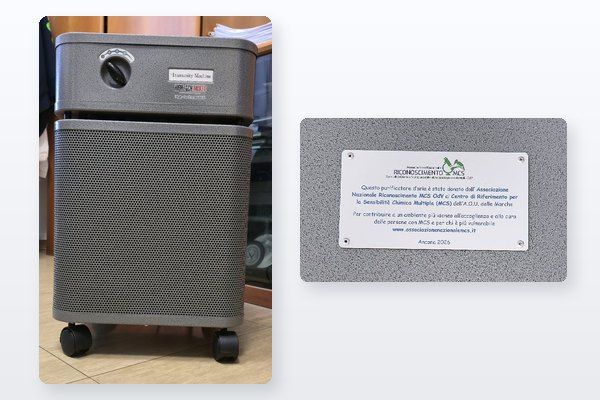 An air purifier donated to the MCS Reference Center in Ancona: a project made possible by the 5x1000Read more: An air purifier donated to the MCS Reference Center in Ancona: a project made possible by the 5x1000
The National Association for the Recognition of MCS donated an Austin Air Immunity Machine® air purifier to the MCS...
-
 Dog and cat odors at home: how to get rid of litter box ammonia tooRead more: Dog and cat odors at home: how to get rid of litter box ammonia too
The ammonia smell of the litter box, a wet dog's coat, hair and allergens everywhere: anyone living with dogs and...
Blog categories
Search in blog

Scented candles, incense and diffusers: what they release into your indoor air
In December windows stay closed for longer, while homes fill up with scented candles, incense sticks, wax melts and fragrance diffusers. They create atmosphere, but they also release substances into the air we breathe.
In this article we look at what scientific studies say about the particles, VOCs and nanoparticles produced by these sources, why the topic matters especially to people who are sensitive to fragrances, and how to reduce exposure without giving up the pleasure of the holidays altogether.
Candles: more than the smoke you can see
A lit candle looks harmless, but it is in every respect a small combustion inside the home. Researchers at Lund University (Sweden) studied the particles emitted by candles in three different phases:
Steady flame
Even when the flame is still, the candle emits a large number of ultrafine particles. According to the authors, the most likely source is the flame retardant additives in the wick.
Sooting flame
When the flame flickers and blackens, larger carbon (soot) particles are added. This is the phase with the highest emissions by mass.
Extinguishing
The wisp of smoke rising from a freshly extinguished wick consists mainly of organic matter: a short emission, but concentrated close to the person putting out the candle.
A more recent study, published in Indoor Air in 2021, compared five types of pillar candles. Two findings are useful in everyday life: the composition of wax and wick strongly affects emissions of soot, PM2.5 and polycyclic aromatic hydrocarbons (PAHs), and a flame disturbed by draughts emits more. Avoiding this "stressed" burning reduces exposure to pollutants.
Incense: very high particle peaks
Incense burns slowly and without a flame, but it produces smoke rich in fine particles. In a study carried out in a room of a home where incense was burned regularly, during burning episodes indoor PM2.5 reached average hourly peaks of 571 µg/m³, while outdoor levels remained almost unchanged: a sign that the source was entirely inside the home.
A 2023 scientific review lists among the substances in incense smoke, in addition to particles, also carbon monoxide, nitrogen dioxide, VOCs and PAHs. The good news is that particles do not stay in the air forever: in a study carried out in homes, PM10 and PM2.5 returned to background levels about an hour after burning ended. Ventilating and filtering the air shortens this time further.
"Flame-free" does not mean emission-free
Scented wax melts and essential oil diffusers are often presented as cleaner alternatives to candles and incense, because there is no combustion. Studies by Purdue University (United States), carried out in an experimental house equipped as a laboratory, tell a different story.
Fragrances release terpenes (for example limonene and pinene), the molecules responsible for the scent. In indoor air, terpenes react with ozone, which enters from outdoors, and form new, extremely small particles: with scented wax melts the researchers measured more than one million nanoparticles per cubic centimetre. With unscented wax melts, on the other hand, neither terpenes nor nanoparticles were formed. The same group observed the phenomenon with essential oil diffusers, air fresheners and scented sprays as well.
Good to know: the authors themselves stress that the health effects of these nanoparticles still need to be studied. The message is not alarmist, but practical: fragrance in the air is itself a source of pollution, even when no smoke is visible.
Fragrances and chemical sensitivity
For many people the problem is not just theoretical. A survey of representative samples of the population in the United States, Australia, the United Kingdom and Sweden found that 32.2% of adults report health problems from fragranced products. In particular, 17.4% point to air fresheners and 15.7% to rooms cleaned with scented products.
The topic is especially relevant to people living with multiple chemical sensitivity (MCS), for whom fragrances are often among the hardest triggers to avoid, especially during the holidays and when visiting other people's homes. We also discuss it in the article MCS and air purification and on the page about our dedicated services for people with MCS.
How to reduce exposure during the holidays
Fewer candles, unscented
A few candles, lit for a short time, and unscented where possible: fragrance adds terpenes to what combustion already releases.
Away from draughts
A steady flame emits less soot. Keep candles away from windows, doors and radiators, where the air moves the most.
Careful when extinguishing
The smoke from a freshly extinguished wick is a concentrated emission: keep it away from your face and do not leave the wick smouldering for long.
Ventilate after use
After candles or incense, open the windows for a few minutes: air exchange dilutes particles and gases more quickly.
Diffusers in moderation
Wax melts, diffusers and air fresheners should not become a daily habit, especially in the bedroom.
Air purifier on
An air purifier with HEPA and activated carbon works continuously on particles and VOCs, even when the windows have to stay closed.
Using an air purifier with candles, incense and fragrances
The first line of defence is always reducing the source: no air purifier makes a room "clean" if incense is burned there all day. A good air purifier, however, helps a great deal in bringing the air back to normal more quickly, because it acts on both components of these emissions:
- Particles and soot: the medical-grade HEPA filter in Austin Air purifiers captures 99.97% of particles at 0.3 µm and 99% at 0.1 µm (official Austin Air data).
- VOCs and terpenes: the bed of coconut shell activated carbon and zeolite (up to 6.8 kg in the standard models) adsorbs gases, odours and VOCs. Coconut carbon is rich in micropores, the best suited to trapping VOCs at the low concentrations typical of indoor environments: we explore this in the article coconut or coal-based carbon for VOCs.
- Contact time: air enters from all sides (360° intake) and passes through the carbon layer that completely surrounds the HEPA filter. The slower passage favours the adsorption of gases and odours.
- No ozone, no ions: filtration is exclusively mechanical and by adsorption. This detail matters precisely here, because fragrance nanoparticles form from the reaction between terpenes and ozone.
Which Austin Air model to choose

Bedroom Machine
Designed for the bedroom: in addition to activated carbon and zeolite it adds military-grade HEGA carbon cloth as the last stage before the air exits. No impregnated materials, and recommended by Austin Air for chemical sensitivities as well.

HealthMate Plus
Part of the carbon is impregnated with potassium iodide, to boost its action on VOCs and aggressive chemicals. Austin Air indicates it as the best choice for people with MCS and for those sensitive to fragrances and cleaning products.

Immunity Machine
Combines potassium iodide impregnated carbon, two mineral stages (one with a proprietary impregnation for nitrogen-based gases) and HEGA cloth: the solution for those who want both.

Austin "it" VOC Wrap
Compact, for desks, bedside tables and travel: in place of the large particle pre-filter it fits an activated carbon wrap that adsorbs odours, gases and VOCs. Austin Air recommends it for people with chemical sensitivities.
Models with impregnated materials (HealthMate Plus and Immunity Machine) are also used regularly by a growing number of people with MCS. For those who prefer non-impregnated materials, the alternatives are the HealthMate, Bedroom Machine and HealthMate Junior, as well as the Austin "it". On request, before delivery we offer free off-gassing of the air purifier (7 days, extendable).
Frequently asked questions
Are soy or beeswax candles better?
Studies show that the composition of wax and wick significantly changes emissions, but no candle is emission-free: it is still combustion. If the candle is also scented, the terpenes of the fragrance are added to the particles.
Are natural essential oils harmless?
"Natural" does not mean "emission-free". Essential oils are rich in terpenes such as limonene and pinene, which react with ozone in indoor air and form nanoparticles. An analysis of 37 fragranced products identified more than 156 VOCs emitted, the most common being limonene and pinene, including in products marketed as "green" or organic.
Can I keep the air purifier on while a candle is lit?
Yes, in fact that is when it is needed most. During use and for the following hour it is worth running it at medium or high speed, remembering to ventilate the room as soon as possible. The air purifier should be placed at least 10 cm from the wall.
Do candles wear out the filter faster?
Smoke and strong odours are among the factors that shorten filter life, which reaches up to 5 years in normal domestic use. Occasional use during the holidays has little impact; daily use of incense or candles, on the other hand, does make a difference.
Useful links
- VOCs at home: where they come from and how to reduce them with activated carbon
- HEGA cloth: what military-grade activated carbon is
- Fireplaces and wood stoves: how to protect your indoor air
- A gift you can breathe: Austin Air ideas for the people you love
- Austin Air air purifier buying guide
Sources
- Pagels J. et al., Chemical composition and mass emission factors of candle smoke particles, Journal of Aerosol Science, 2009: doi.org/10.1016/j.jaerosci.2008.10.005
- Andersen C. et al., Emissions of soot, PAHs, ultrafine particles, NOx, and other health relevant compounds from stressed burning of candles in indoor air, Indoor Air, 2021: doi.org/10.1111/ina.12909
- Levels of Selected Indoor Air Pollutants: A Case Study in a Residential Room with Incense Burning Practice: scientific.net/EH.40.93
- Guo S.E. et al., Contributions of burning incense on indoor air pollution levels and on the health status of patients with chronic obstructive pulmonary disease, PeerJ, 2020: peerj.com/articles/9768
- Patra S.S. et al., Flame-Free Candles Are Not Pollution-Free: Scented Wax Melts as a Significant Source of Atmospheric Nanoparticles, Environmental Science & Technology Letters, 2025: pmc.ncbi.nlm.nih.gov/articles/PMC11823451
- Purdue University, Air inside your home may be more polluted than outside due to everyday chemical products, 2025: sciencedaily.com
- Steinemann A., International prevalence of fragrance sensitivity, Air Quality, Atmosphere & Health: portfolio.jcu.edu.au
- Steinemann A., Fragranced consumer products: exposures and effects from emissions, Air Quality, Atmosphere & Health, 2016: link.springer.com
Not sure which model is right for your home? Write to us, we reply 7 days a week.
 Contact us
 WhatsApp (chat only)
Note: this article is for information purposes only. Air purifiers are not medical devices and do not replace medical advice. If symptoms persist, consult your doctor.
Posted in:
Air Quality Blog
Related posts
-
 Asthma and Indoor Air Quality: What Science Says and How to Protect Yourself
Asthma affects over 3 million people in Italy and often worsens at night, when exposure to bedroom allergens is...Read more
-
 Ten independent clinical trials on Austin Air: what they show
Eight published studies and two in progress, conducted by eight independent research institutions on asthma,...Read more
-
 HEPA air purifier: how it works, what it is for and how to choose one
What a HEPA air purifier is, what it is for and how it works, how to choose one for your room and the most common...Read more
-
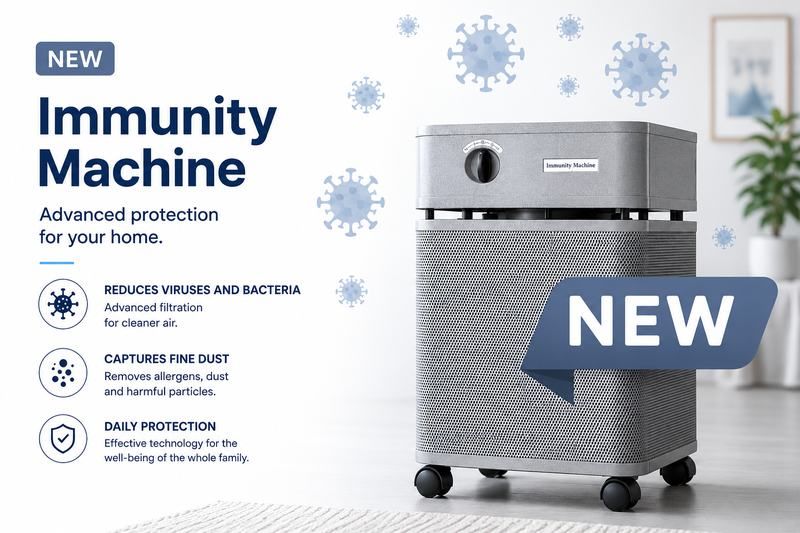 Austin Air announces the launch of the Immunity Machine, its most advanced air purifier.
Austin Air introduces the Immunity Machine, its most advanced air purifier: 8-phase filtration with medical-grade...Read more
-
 MCS and Air Purification: A Guide to More Livable Spaces
A practical guide to air purification for people with MCS and chemical sensitivity: how to choose the right purifier,...Read more
Leave a comment