In winter we spend almost all our time indoors with the windows closed. Ventilation removes CO₂ and humidity, while...

Latest posts
-
 Closed windows in winter: ventilation and air purifier, the right pair for your indoor airRead more: Closed windows in winter: ventilation and air purifier, the right pair for your indoor air
-
 Renovation and indoor air: dust, paint and VOCs, how to protect yourself during and after the workRead more: Renovation and indoor air: dust, paint and VOCs, how to protect yourself during and after the work
A renovation changes the air at home twice: during the work because of dust, afterwards because of VOCs from paint,...
-
 Gas stoves and indoor air: nitrogen dioxide, benzene and how to protect yourselfRead more: Gas stoves and indoor air: nitrogen dioxide, benzene and how to protect yourself
In Italy more than half of all homes cook with gas. Studies show that the flame releases nitrogen dioxide, benzene...
-
 Scented candles, incense and diffusers: what they release into your indoor airRead more: Scented candles, incense and diffusers: what they release into your indoor air
Candles, incense, wax melts and diffusers make the holiday atmosphere warmer, but they release particles,...
-
 Microplastics and nanoplastics in indoor air: what they are, how many we breathe and how to reduce themRead more: Microplastics and nanoplastics in indoor air: what they are, how many we breathe and how to reduce them
Microplastics are also in the air at home, far more than was thought. What micro- and nanoplastics are, where...
-
 HEGA cloth: what military-grade activated carbon does in Austin Air filtersRead more: HEGA cloth: what military-grade activated carbon does in Austin Air filters
HEGA cloth is the military-grade activated carbon in the Bedroom Machine and Immunity Machine filters. What it is,...
-
 A gift you can breathe: Austin Air ideas for your loved ones (and for you)Read more: A gift you can breathe: Austin Air ideas for your loved ones (and for you)
Some gifts end up in a drawer, others work every day, quietly, for many years. Here is which Austin Air purifier to...
-
 Coconut or coal-based carbon: which is better for VOCsRead more: Coconut or coal-based carbon: which is better for VOCs
Coconut shell or coal: two materials with different pores. Here is what the studies say and which works best with...
-
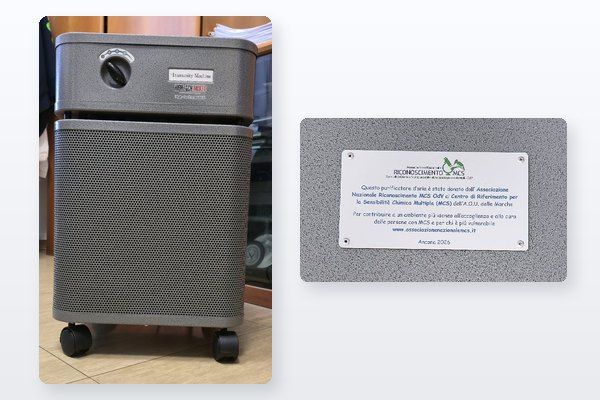 An air purifier donated to the MCS Reference Center in Ancona: a project made possible by the 5x1000Read more: An air purifier donated to the MCS Reference Center in Ancona: a project made possible by the 5x1000
The National Association for the Recognition of MCS donated an Austin Air Immunity Machine® air purifier to the MCS...
-
 Dog and cat odors at home: how to get rid of litter box ammonia tooRead more: Dog and cat odors at home: how to get rid of litter box ammonia too
The ammonia smell of the litter box, a wet dog's coat, hair and allergens everywhere: anyone living with dogs and...
Blog categories
Search in blog

Gas stoves and indoor air: nitrogen dioxide, benzene and how to protect yourself
In Italy more than half of all homes cook with gas. In winter we cook more, often with the windows closed, and everything the flame releases stays in the air at home for longer.
In this article we look at what recent studies say about the nitrogen dioxide, benzene and ultrafine particles produced by gas stoves, how much a range hood really helps and what you can do to protect the air in your kitchen and the rest of your home.
What a gas flame releases
When gas burns, several substances form along with the heat. Laboratory tests carried out by the Dutch institute TNO for the European study promoted by CLASP and EPHA detected, during gas cooking:
Nitrogen dioxide (NO₂)
The irritant gas also typical of traffic. It forms at high temperature from the nitrogen and oxygen in the air, so every flame produces it.
Ultrafine particles
Extremely small particles formed during combustion that can penetrate deep into the airways.
Carbon monoxide
An odourless, invisible gas, dangerous at high concentrations. That is why good combustion and a detector are essential.
To these we can add benzene, measured by a team of researchers at Stanford University, which we discuss further on.
Nitrogen dioxide: limits exceeded in the kitchen
The European study simulated a typical kitchen without mechanical ventilation. The result: with gas, nitrogen dioxide exceeds World Health Organization guidelines and European outdoor air standards several times a week, all year round. In all simulations without mechanical ventilation, the European hourly limit of 200 µg/m³ was exceeded more often than the 18 hours per year allowed.
Based on these data, the study's promoters estimate that in the European Union more than 700,000 children have had asthma symptoms attributable to gas cooking, about 12% of childhood asthma cases.
Good to know: these are estimates based on simulations, not measurements in every single home. They do, however, show clearly that without good air exchange, a gas kitchen can become a significant source of indoor pollution.
Benzene: it also spreads to other rooms
A Stanford University study published in 2023 in Environmental Science & Technology measured benzene, a carcinogenic substance, emitted by stoves and ovens in dozens of homes. The main findings:
- gas stoves and ovens emit 10 to 50 times more benzene than electric ones;
- induction hobs emitted no detectable benzene;
- a single burner on high, or the oven at about 175 °C, can raise indoor benzene above average levels of secondhand smoke;
- benzene spreads to other rooms, bedrooms included, and stays in the air for hours;
- benzene comes from the fuel, not the food: pan-frying produced none.
The range hood matters, but it is not enough on its own
A study by Lawrence Berkeley National Laboratory, published in 2026, followed more than 4,000 cooking events in real homes with gas stoves. When cooking without the range hood, nitrogen dioxide concentrations were about 45% higher than when the hood was on. The lowest levels were achieved by running the hood for more than half of the cooking time.
The range hood therefore remains the first line of defence, but it is not enough on its own: the Stanford researchers observed that it often does not eliminate benzene exposure, even when it vents outdoors.
How to protect the air when you cook with gas
Range hood always on
Switch it on every time you cook, even briefly, and keep it running throughout: that is where it makes a difference.
Window open
Even in winter, open the window for a few minutes during and after cooking: air exchange dilutes the gases.
Never for heating
Never use the oven or stove to heat your home: it increases combustion gases and the risk of carbon monoxide.
CO detector
A certified carbon monoxide detector is simple, inexpensive protection for the whole home.
Induction, if you renovate
If you are redoing your kitchen, consider an induction hob: with no flame there are no combustion gases.
Air purifier in the living area
An air purifier with HEPA and activated carbon works continuously on particles and gases, even after cooking.
Using an air purifier when you cook with gas
An air purifier does not replace the range hood or air exchange, and it is not protection against carbon monoxide: for that you need proper maintenance of your gas appliances and a detector. It can, however, help a great deal in the hours after cooking and in the other rooms, where pollutants spread and linger:
- Ultrafine particles and fumes: the medical-grade HEPA filter in Austin Air purifiers captures 99.97% of particles at 0.3 µm and 99% at 0.1 µm (official Austin Air data).
- VOCs and cooking odours: the bed of coconut shell activated carbon and zeolite (up to 6.8 kg in the standard models) adsorbs gases, odours and VOCs. We discuss this in the article VOCs at home.
- Nitrogen dioxide: Austin Air lists NO₂ among the gases treated by the HealthMate Plus, thanks to its potassium iodide impregnated carbon. In the Immunity Machine, the mineral stage with proprietary impregnation is described by Austin Air specifically for nitrogen-based gases such as NO₂ from gas stoves and smog.
- Contact time: air enters from all sides (360° intake) and passes through the carbon layer that completely surrounds the HEPA filter. The slower passage favours the adsorption of gases.
Which Austin Air model to choose

Immunity Machine
The most complete for combustion gases: potassium iodide impregnated carbon, mineral filtration, a mineral with proprietary impregnation for nitrogen-based gases and HEGA carbon cloth.

HealthMate Plus
Part of the carbon is impregnated with potassium iodide: Austin Air lists VOCs, formaldehyde, benzene and nitrogen dioxide among the gases it treats.

HealthMate
For those mainly concerned with particles and cooking odours: medical-grade HEPA and up to 6.8 kg of non-impregnated activated carbon and zeolite.

Austin "it" VOC Wrap
Compact, for worktops and small spaces: in place of the large particle pre-filter it fits an activated carbon wrap that, according to Austin Air, adsorbs odours, gases and VOCs.
Models with impregnated materials (HealthMate Plus and Immunity Machine) are also used regularly by a growing number of people with MCS. For those who prefer non-impregnated materials, the alternatives are the HealthMate, Bedroom Machine and HealthMate Junior, as well as the Austin "it".
Frequently asked questions
Does induction solve the problem?
With induction there is no flame, so the stove's combustion gases disappear: in the Stanford study, induction hobs emitted no detectable benzene. Cooking itself, especially frying and high-temperature cooking, still produces fumes and odours: the range hood remains useful with induction too.
Does the air purifier remove carbon monoxide?
No. The air purifier is not protection against carbon monoxide. For CO you need proper maintenance of your boiler and stove, good ventilation and a certified detector.
Where should I place the air purifier if I have an open-plan kitchen?
In the living area, near the kitchen but not right next to the stove, where steam and grease would reach the pre-filter directly. Leave at least 10 cm from the wall so that air can enter freely from all sides.
Useful links
- Urban air pollution and traffic: what we really breathe in cities
- VOCs at home: where they come from and how to reduce them with activated carbon
- Fireplaces and wood stoves: how to protect your indoor air
- Scented candles, incense and diffusers: what they release into your indoor air
- Austin Air air purifier buying guide
Sources
- CLASP and EPHA, with technical support from TNO, Gas cookers regularly breach air pollution limits: clasp.ngo
- Kashtan Y.S. et al., Gas and Propane Combustion from Stoves Emits Benzene and Increases Indoor Air Pollution, Environmental Science & Technology, 2023: doi.org/10.1021/acs.est.2c09289
- Fang Y. et al., Range Hood Use and Effectiveness in Reducing Indoor Air Pollution During Gas and Induction Cooking, E3S Web of Conferences, 2026: doi.org/10.1051/e3sconf/202671601054
Not sure which model is right for your home? Write to us, we reply 7 days a week.
 Contact us
 WhatsApp (chat only)
Note: this article is for information purposes only. Air purifiers are not medical devices and do not replace medical advice, proper kitchen ventilation or the maintenance of gas appliances.
Posted in:
Air Quality Blog
Related posts
-
 Asthma and Indoor Air Quality: What Science Says and How to Protect Yourself
Asthma affects over 3 million people in Italy and often worsens at night, when exposure to bedroom allergens is...Read more
-
 Ten independent clinical trials on Austin Air: what they show
Eight published studies and two in progress, conducted by eight independent research institutions on asthma,...Read more
-
 HEPA air purifier: how it works, what it is for and how to choose one
What a HEPA air purifier is, what it is for and how it works, how to choose one for your room and the most common...Read more
-
 Austin Air announces the launch of the Immunity Machine, its most advanced air purifier.
Austin Air introduces the Immunity Machine, its most advanced air purifier: 8-phase filtration with medical-grade...Read more
-
 MCS and Air Purification: A Guide to More Livable Spaces
A practical guide to air purification for people with MCS and chemical sensitivity: how to choose the right purifier,...Read more
Leave a comment