Coconut shell or coal: two materials with different pores. Here is what the studies say and which works best with...

Latest posts
-
 Coconut or coal-based carbon: which is better for VOCsRead more: Coconut or coal-based carbon: which is better for VOCs
-
 An air purifier donated to the MCS Reference Center in Ancona: a project made possible by the 5x1000Read more: An air purifier donated to the MCS Reference Center in Ancona: a project made possible by the 5x1000
The National Association for the Recognition of MCS donated an Austin Air Immunity Machine® air purifier to the MCS...
-
 Dog and cat odors at home: how to get rid of litter box ammonia tooRead more: Dog and cat odors at home: how to get rid of litter box ammonia too
The ammonia smell of the litter box, a wet dog's coat, hair and allergens everywhere: anyone living with dogs and...
-
 Saharan dust and Etna ash: what they are and how to protect the air at homeRead more: Saharan dust and Etna ash: what they are and how to protect the air at home
Yellow skies from African dust and falls of Etna ash: two increasingly frequent natural phenomena that bring fine...
-
 Floods and indoor air: what happens afterwards and how to protect yourselfRead more: Floods and indoor air: what happens afterwards and how to protect yourself
After a flood, the air problem does not end when the water recedes: mold, bacteria, dust and odors can linger at home...
-
 Austin Air announces the launch of the Immunity Machine, its most advanced air purifier.Read more: Austin Air announces the launch of the Immunity Machine, its most advanced air purifier.
Austin Air introduces the Immunity Machine, its most advanced air purifier: 8-phase filtration with medical-grade...
-
 MCS and Air Purification: A Guide to More Livable SpacesRead more: MCS and Air Purification: A Guide to More Livable Spaces
A practical guide to air purification for people with MCS and chemical sensitivity: how to choose the right purifier,...
-
 Air Purifiers: Complete Guide and How to Choose the Right OneRead more: Air Purifiers: Complete Guide and How to Choose the Right One
How to choose the right air purifier: HEPA and carbon filters, sizing, noise, running costs and maintenance....
-
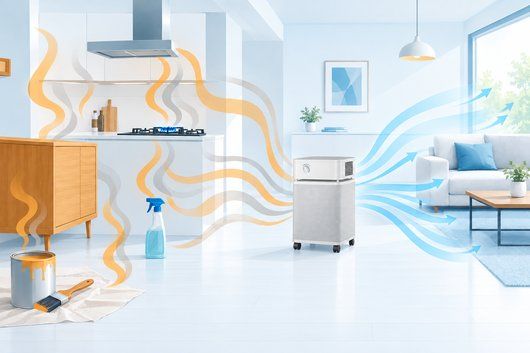 VOCs at home: what they are, where they hide and how to really remove themRead more: VOCs at home: what they are, where they hide and how to really remove them
Paint, new furniture, cleaning products and gas stoves release VOCs that no HEPA filter can stop. Discover where they...
-
 Extreme heat and air quality: what changes and how to protect yourselfRead more: Extreme heat and air quality: what changes and how to protect yourself
Extreme heat worsens the air quality we breathe, affecting everyone and especially people with MCS. Causes, updated...
Blog categories
Search in blog
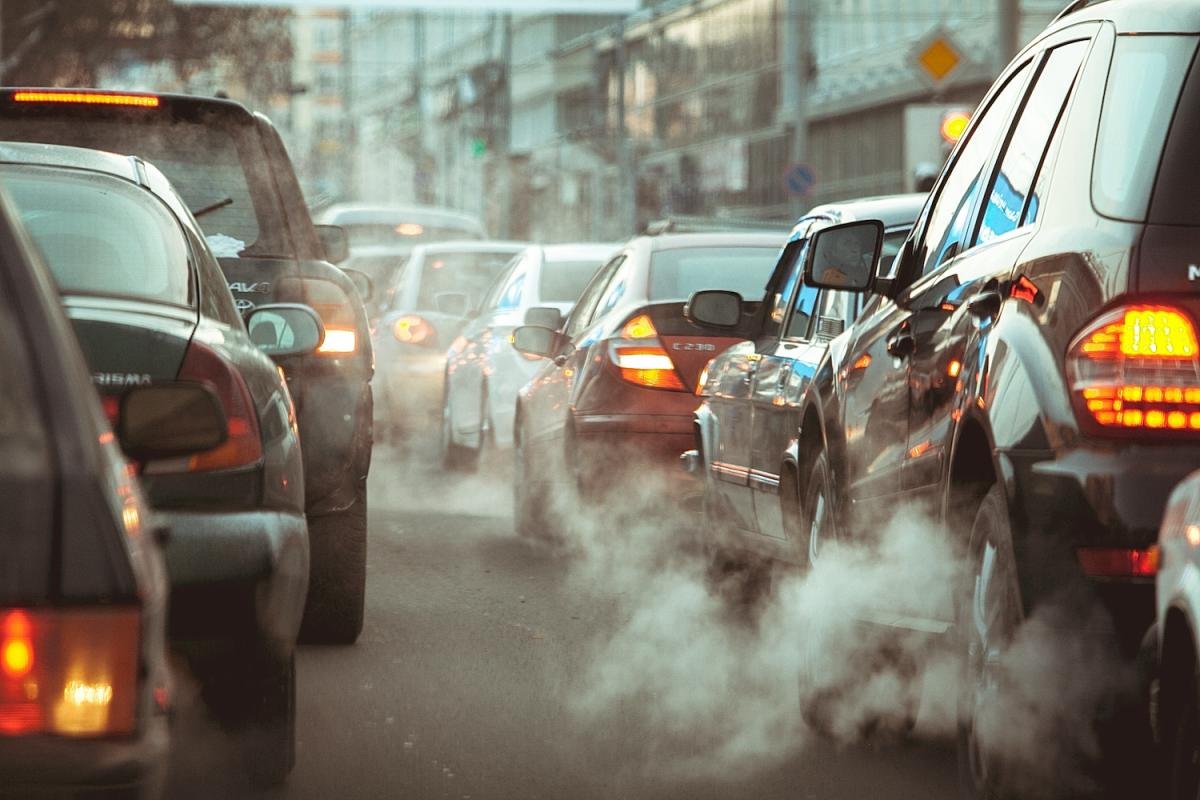
Urban Air Pollution and Traffic: What We Really Breathe in Cities
Living near traffic changes the air you breathe, indoors and out. What PM2.5, urban gases and VOCs are, why brakes and tyres matter more and more, and how to reduce indoor exposure.
Updated: • Reading: ~8 min
Living near a busy road changes the air you breathe
Opening a window in the city does not guarantee clean air. For millions of people living near busy roads, junctions or urban arteries, the air they breathe every day contains higher concentrations of pollutants than in less exposed areas.
This is not only about days of visible smog or environmental emergencies. In modern cities it is an everyday condition, often invisible but constant. One figure sums up how widespread the problem is: according to the European Environment Agency, 96% of the EU's urban population is exposed to PM2.5 concentrations above the WHO guideline value.
Traffic as a continuous source of exposure
Unlike industrial emissions, which are localised and regulated, road traffic produces emissions at ground level, exactly where people walk, wait for the bus or open their windows.
Not everything comes from the tailpipe. There are three main families of sources:
Particulate matter (PM2.5 and PM10)
From engine combustion but also, increasingly, from the wear of brakes, tyres and road surface and from the resuspension of settled dust.
Polluting gases
Nitrogen oxides (NO2), carbon monoxide (CO) and, indirectly, tropospheric ozone, which build up along arteries and at junctions.
VOCs (volatile organic compounds)
Such as benzene and toluene, released by fuels, exhaust gases and evaporation, among the precursors of ozone.
This combination makes traffic one of the most pervasive sources of exposure in urban areas, because it acts on several fronts at once: solid particles and gaseous pollutants.
PM2.5: the invisible enemy of cities
Of all urban air pollutants, PM2.5 is the one that raises the greatest health concern. These particles are so small they are invisible to the naked eye, yet light enough to stay suspended for long periods.
What PM2.5 is
PM2.5 covers particles with a diameter below 2.5 micrometres. For comparison, a human hair is about 30 times thicker.
These particles bypass the natural defences of the airways, reach the pulmonary alveoli and, in some cases, enter the bloodstream.
WHO 2021 guideline value for PM2.5:
5 µg/m³ annual mean (halved from the 10 of 2005) and 15 µg/m³ over 24 hours. For nitrogen dioxide (NO2) the annual value dropped to 10 µg/m³.
In cities, a significant share of PM2.5 is linked to traffic. Even outside rush hour, concentrations can stay high in narrow streets and in neighbourhoods with a high density of vehicles.
Not just the tailpipe: brakes, tyres and road dust
For years the focus was on exhaust gases. But with ever cleaner engines and stricter anti-pollution rules, the balance has shifted towards so-called non-exhaust emissions: the particles produced by the wear of brakes, tyres and road surface, plus the resuspension of settled dust.
According to the European Environment Agency, brakes and tyres now account for about 77% of PM10 and 60% of PM2.5 emitted by road transport in the EU.
One often misunderstood point concerns electric cars. Having no exhaust, they cut combustion emissions to zero, but they do not eliminate non-exhaust emissions: being heavier because of their batteries, they tend to increase tyre and road wear. Regenerative braking greatly reduces brake dust, but the tyre and road component remains. In other words, traffic particulate does not disappear with electrification: it simply changes source.
Gases and VOCs: the part you cannot see
Beyond solid particles, a significant part of daily exposure comes from polluting gases and volatile organic compounds (VOCs), often underestimated compared with fine particles.
Gases of vehicular origin
Traffic emits nitrogen oxides (NO2), carbon monoxide (CO) and, indirectly, tropospheric ozone. These gases tend to concentrate along urban arteries and at high-intensity junctions.
VOCs: what they are and why they matter
VOCs are a broad family of chemicals released by fuels, exhaust gases and fuel evaporation. Among the most common in cities are benzene, toluene and formaldehyde. Some contribute to the formation of secondary pollutants such as ozone, while others are associated with irritant effects and health risks under chronic exposure.
Why some streets are more polluted than others
The shape of cities affects air quality. Narrow streets flanked by tall buildings create the so-called urban canyon effect, in which the air stagnates and pollutants build up.
In these settings, even a moderate amount of traffic can translate into high levels of PM2.5, gases and VOCs.
Pollution does not stay outside
An often overlooked aspect is that urban pollutants do not stop outdoors. PM2.5, along with gases and VOCs, easily penetrates buildings through windows, doors and ventilation systems.
We spend over 90% of our time indoors: this is why indoor air quality is a fundamental part of overall exposure.
Outdoor and indoor: continuous exposure
In high-traffic urban areas a significant share of the PM2.5 and VOCs found indoors comes from outside. Living near a busy road, therefore, directly affects indoor air quality.
How to reduce indoor exposure
Alongside traffic reduction policies, there are individual measures that help limit exposure at home. The most effective ones:
- Ventilate at the right times: choose low-traffic hours and avoid opening the street-side windows wide during rush hour.
- Reduce indoor sources: smoke, candles, scented products and solvents add to the load coming from outside.
- Filter the air completely: against traffic, one type of filter alone is not enough.
This last point is the most misunderstood. Traffic pollution is made of two different components: particles (PM2.5) and gases or VOCs (NO2, benzene). A HEPA filter captures particles but not gases, while activated carbon traps gases and VOCs but not dust. A HEPA-only purifier therefore addresses only half the problem.
This is why high-efficiency filtration systems designed for urban environments, such as those from Austin Air, combine a medical-grade HEPA filter with a layer of activated carbon, acting on both fine particulate and gaseous pollutants. To work out which model suits your room, you can use the air changes calculator or start from the buying guide.
Conclusion
Urban traffic pollution is not an occasional problem but a daily reality that affects both outdoor and indoor air quality. It is no longer only a matter of tailpipes: brakes, tyres and road dust are now a major component, and they keep weighing in even with electric cars.
Understanding what this pollution is made of and how it enters our homes is the first step to tackling it consciously. If you want to explore how to reduce indoor exposure, read our complete guide to air purifiers.
Useful links
 Austin Air purifier buying guide
 Compare the Austin Air models
 Air changes calculator
 Fireplaces and wood stoves: protecting indoor air
- Wildfires and air quality
- Formaldehyde at home: risks and protection
 All Austin Air purifiers
 Contact us
Note: air purifiers are not medical devices. Information on pollutants and exposure refers to independent studies and scientific sources; the effectiveness of indoor filtration may vary depending on use, environment and the substances present.
Sources: World Health Organization, Global Air Quality Guidelines 2021; European Environment Agency, non-exhaust emissions from road transport (2023); European Environment Agency, Europe's air quality status 2024.
Posted in:
Air Quality Blog
Related posts
-
 Asthma and Indoor Air Quality: What Science Says and How to Protect Yourself
Asthma affects over 3 million people in Italy and often worsens at night, when exposure to bedroom allergens is...Read more
-
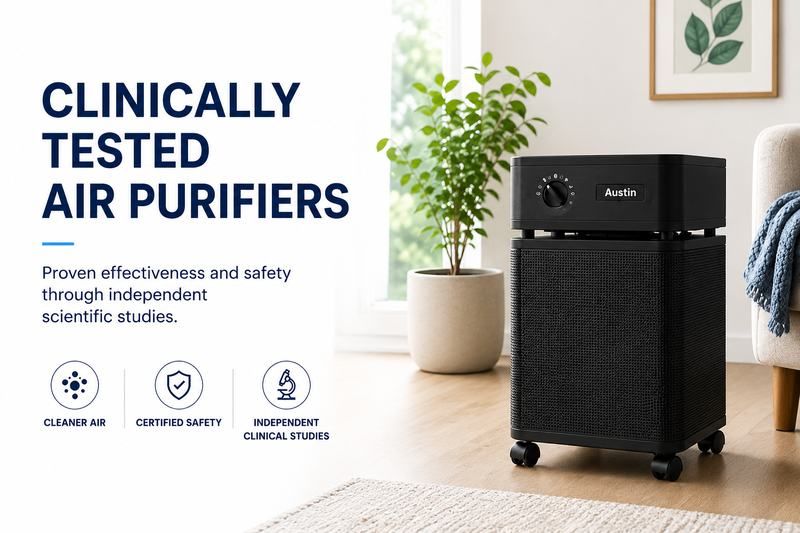 Ten independent clinical trials on Austin Air: what they show
Eight published studies and two in progress, conducted by eight independent research institutions on asthma,...Read more
-
Air Purifiers: Complete Guide and How to Choose the Right One
How to choose the right air purifier: HEPA and carbon filters, sizing, noise, running costs and maintenance....Read more
-
Austin Air announces the launch of the Immunity Machine, its most advanced air purifier.
Austin Air introduces the Immunity Machine, its most advanced air purifier: 8-phase filtration with medical-grade...Read more
-
MCS and Air Purification: A Guide to More Livable Spaces
A practical guide to air purification for people with MCS and chemical sensitivity: how to choose the right purifier,...Read more
Leave a comment