Coconut shell or coal: two materials with different pores. Here is what the studies say and which works best with...

Latest posts
-
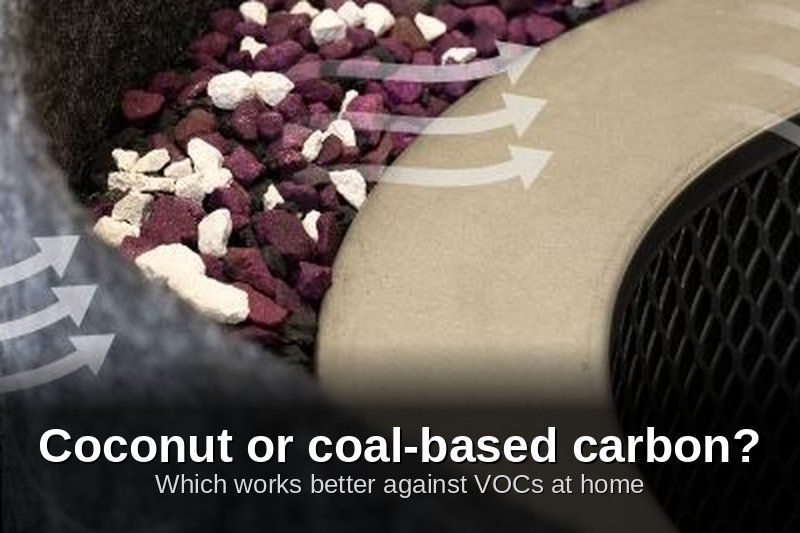 Coconut or coal-based carbon: which is better for VOCsRead more: Coconut or coal-based carbon: which is better for VOCs
-
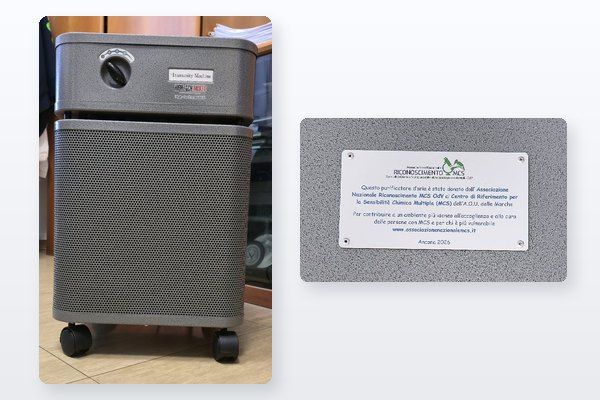 An air purifier donated to the MCS Reference Center in Ancona: a project made possible by the 5x1000Read more: An air purifier donated to the MCS Reference Center in Ancona: a project made possible by the 5x1000
The National Association for the Recognition of MCS donated an Austin Air Immunity Machine® air purifier to the MCS...
-
 Dog and cat odors at home: how to get rid of litter box ammonia tooRead more: Dog and cat odors at home: how to get rid of litter box ammonia too
The ammonia smell of the litter box, a wet dog's coat, hair and allergens everywhere: anyone living with dogs and...
-
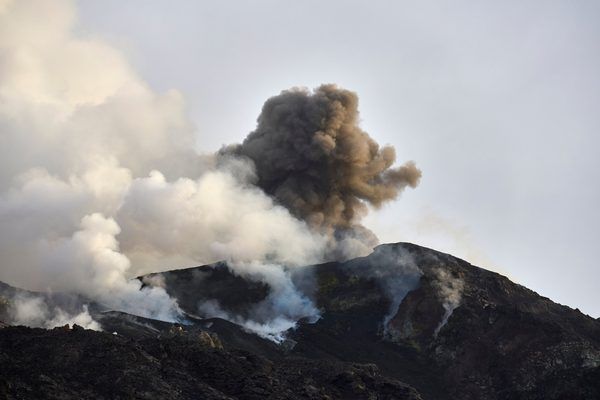 Saharan dust and Etna ash: what they are and how to protect the air at homeRead more: Saharan dust and Etna ash: what they are and how to protect the air at home
Yellow skies from African dust and falls of Etna ash: two increasingly frequent natural phenomena that bring fine...
-
 Floods and indoor air: what happens afterwards and how to protect yourselfRead more: Floods and indoor air: what happens afterwards and how to protect yourself
After a flood, the air problem does not end when the water recedes: mold, bacteria, dust and odors can linger at home...
-
 Austin Air announces the launch of the Immunity Machine, its most advanced air purifier.Read more: Austin Air announces the launch of the Immunity Machine, its most advanced air purifier.
Austin Air introduces the Immunity Machine, its most advanced air purifier: 8-phase filtration with medical-grade...
-
 MCS and Air Purification: A Guide to More Livable SpacesRead more: MCS and Air Purification: A Guide to More Livable Spaces
A practical guide to air purification for people with MCS and chemical sensitivity: how to choose the right purifier,...
-
 Air Purifiers: Complete Guide and How to Choose the Right OneRead more: Air Purifiers: Complete Guide and How to Choose the Right One
How to choose the right air purifier: HEPA and carbon filters, sizing, noise, running costs and maintenance....
-
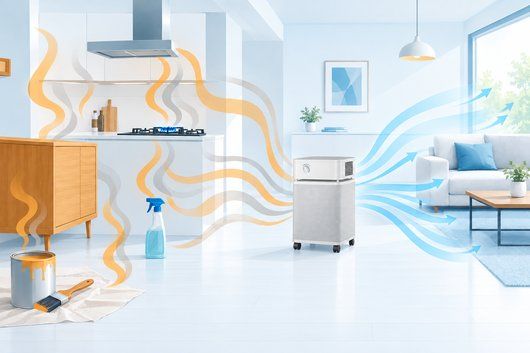 VOCs at home: what they are, where they hide and how to really remove themRead more: VOCs at home: what they are, where they hide and how to really remove them
Paint, new furniture, cleaning products and gas stoves release VOCs that no HEPA filter can stop. Discover where they...
-
 Extreme heat and air quality: what changes and how to protect yourselfRead more: Extreme heat and air quality: what changes and how to protect yourself
Extreme heat worsens the air quality we breathe, affecting everyone and especially people with MCS. Causes, updated...
Blog categories
Search in blog
Coconut or coal-based carbon: which is better for VOCs
When it comes to air purifiers and VOCs, people almost always look at how much activated carbon the filter contains. But what it is made of matters too: coconut shell carbon and coal-based carbon have different pores, and each traps different substances better. Let's see what the studies say, and which works best with the air in your home.
Updated: October 2026 • Reading time: ~7 min
Why the type of carbon matters, not just the amount
Activated carbon traps gases by adsorption: molecules stick to the walls of millions of microscopic pores. The amount of carbon decides how much it can hold before becoming saturated; the type of carbon decides which molecules it holds best, because that depends on the size of its pores. We have already covered how VOCs are removed in our article VOCs at home: what they are and how to really remove them: here we focus on the material.
Micropores and mesopores, in simple terms
Micropores
Pores smaller than 2 nanometres. They are the ideal "trap" for small molecules and for gases present at low concentrations, because the close walls hold them more strongly.
Mesopores
Pores between 2 and 50 nanometres. They are better suited to larger molecules and work well when pollutant concentration is high, as in many industrial processes.
Macropores
Pores larger than 50 nanometres. On their own they trap almost nothing: they are the "roads" that lead air to the smaller pores.
Coconut shell and coal-based carbon compared
Air and water filters mainly use two materials: carbon made from coconut shells and carbon made from bituminous coal. According to a technical article published in the trade magazine Water Conditioning & Purification, coconut shell carbon has the most micropores, about 50% more than coal-based carbon, which instead has more mesopores and macropores.
| Coconut shell carbon | Coal-based (bituminous) carbon | |
|---|---|---|
| Pore structure | rich in micropores | broader distribution, with more mesopores |
| Molecules trapped best | small, at low concentration | larger, at higher concentration |
| Hardness | typically harder and more abrasion-resistant | typically less hard |
| Ash and impurities | low | higher, unless acid-washed |
| Origin | renewable raw material | fossil source |
In the same magazine, a laboratory test in water measured how much benzene one gram of carbon holds before saturating: about 11 mg for coconut shell carbon versus about 6 mg for coal-based carbon. It is a useful indication of the trend, but it concerns water, not air, so it should not be read as the performance of an air purifier.
What the air studies say
University of Texas (2013): it depends on concentration
A study by the University of Texas at Arlington compared two commercial carbons, one coconut-based and one coal-based, in adsorbing several gases (xylenes, ethylbenzene and methyl ethyl ketone). With methyl ethyl ketone the two carbons performed similarly. With xylenes and ethylbenzene, however, the coconut carbon held more at low concentrations, the coal-based carbon at high concentrations. The authors' conclusion: both work, but at different concentration levels.
Polytechnic University of Catalonia (2013): coconut carbon on real air
A team at the Polytechnic University of Catalonia tested a commercial coconut shell carbon filter on real air, taken inside and outside an ordinary building, with VOC concentrations much lower than those usually used in the laboratory. In a single pass, the filter removed on average about 65% of indoor-air VOCs and 62% of outdoor-air VOCs, and 100% of ozone. Very low humidity reduced its efficiency.
How to read these data
The Texas study concerns gases typical of landfills, not homes, and compares only two carbons. The Catalonia study uses a thin filter for ventilation systems and measures a single pass of air: in a purifier, air passes through the filter many times an hour. Direct comparison studies in air are few, and performance also depends on the specific quality of each carbon.
Why low concentration matters for home air
At home, VOCs are almost always present in very small amounts: traces of formaldehyde from furniture, solvents from paints, fragrances, cleaning products, exhaust fumes coming in through windows. This is exactly where the micropores of coconut shell carbon perform best. Coal-based carbon, with its wider pores, is better suited to the high loads typical of industrial settings.
There is no best carbon in absolute terms
Anyone claiming that one type of carbon is always superior is oversimplifying. For a home purifier, the type of carbon is one factor, alongside others that are just as important:
Amount
You need kilograms of carbon, not a thin layer: a light coating saturates quickly.
Contact time
The more slowly air passes through the carbon, the more molecules are trapped. Flow area and bed depth matter.
Impregnated media
The most reactive gases, such as formaldehyde, need treated media that neutralise them chemically.
Beware of slogans
If a manufacturer presents its own type of carbon as the only valid one, ask yourself what it is selling. To recognise the most misleading claims, read our guide on how to recognise a good air purifier.
The carbon in Austin Air filters
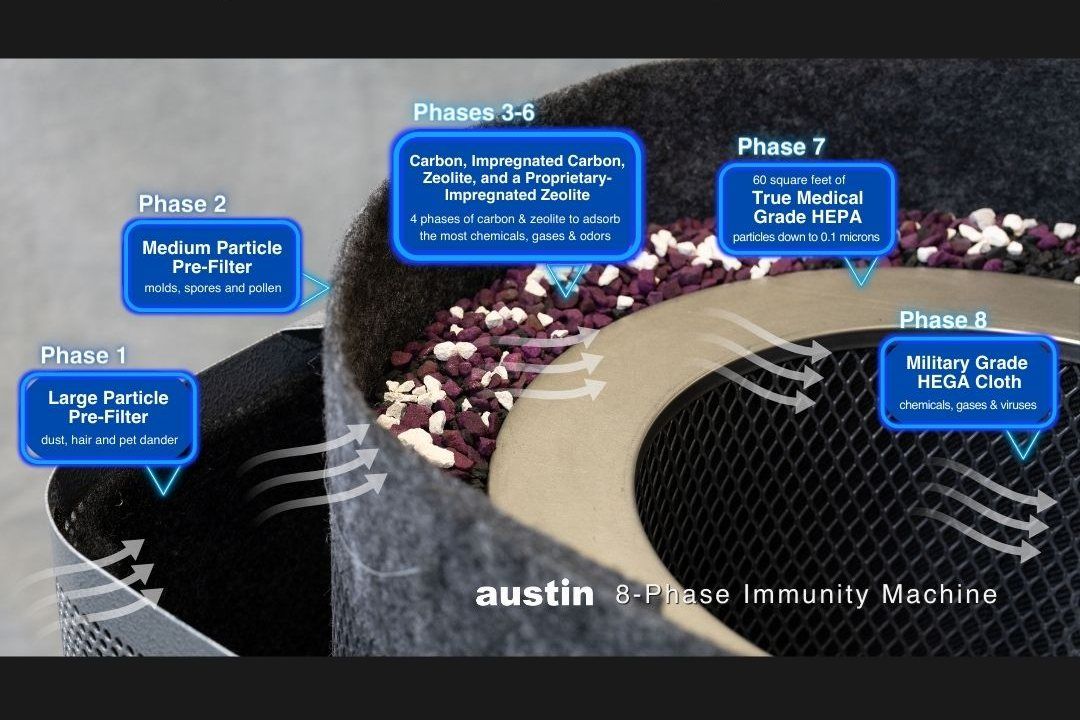
Austin Air filters use coconut shell activated carbon, together with zeolite, in amounts of up to 6.8 kg in standard models and 2.7 kg in Junior models. Thanks to the 360° intake, air passes slowly through the carbon layer surrounding the HEPA filter, with a longer contact time.
- HealthMate: non-impregnated coconut shell carbon and zeolite, for odors and common VOCs
- HealthMate Plus: with part of the carbon impregnated with potassium iodide, more effective on formaldehyde and aggressive chemicals
- Immunity Machine: carbon, potassium iodide-impregnated carbon, natural mineral filtration and a mineral with a proprietary impregnation, plus HEGA cloth
To choose the right model you can use our buying guide or the model comparison, or write to us.
 Contact us
 WhatsApp
Useful links
- VOCs at home: what they are and how to really remove them
- Formaldehyde at home
- Replacement filters guide
- All Austin Air purifiers
Sources: K. Schaeffer, R. Potwora, Coconut shell versus bituminous coal activated carbon, Water Conditioning & Purification; Advantages of water treatment with coconut shell carbons, Water Conditioning & Purification; A. Athappan, M. Sattler, A comparison of bituminous coal-based and coconut shell-based activated carbon for removal of trace hazardous air pollutants in landfill gas, University of Texas at Arlington (2013); E. Gallego et al., Experimental evaluation of VOC removal efficiency of a coconut shell activated carbon filter for indoor air quality enhancement, Building and Environment 67 (2013); official Austin Air Systems technical data.
Note: study data refer to specific test conditions and do not describe the performance of any single purifier. Performance may vary with conditions of use and maintenance. Air purifiers are not medical devices.
Posted in:
Air Quality Blog
Related posts
-
 Asthma and Indoor Air Quality: What Science Says and How to Protect Yourself
Asthma affects over 3 million people in Italy and often worsens at night, when exposure to bedroom allergens is...Read more
-
 Ten independent clinical trials on Austin Air: what they show
Eight published studies and two in progress, conducted by eight independent research institutions on asthma,...Read more
-
Air Purifiers: Complete Guide and How to Choose the Right One
How to choose the right air purifier: HEPA and carbon filters, sizing, noise, running costs and maintenance....Read more
-
Austin Air announces the launch of the Immunity Machine, its most advanced air purifier.
Austin Air introduces the Immunity Machine, its most advanced air purifier: 8-phase filtration with medical-grade...Read more
-
MCS and Air Purification: A Guide to More Livable Spaces
A practical guide to air purification for people with MCS and chemical sensitivity: how to choose the right purifier,...Read more
Leave a comment