Austin Air introduces the Immunity Machine, its most advanced air purifier: 8-phase filtration with medical-grade...

Latest posts
-
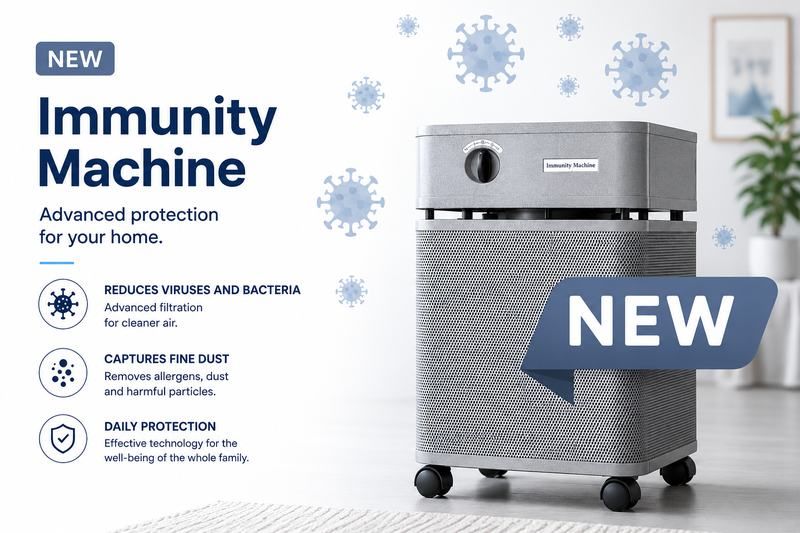 Austin Air announces the launch of the Immunity Machine, its most advanced air purifier.Read more: Austin Air announces the launch of the Immunity Machine, its most advanced air purifier.
 -
 MCS and Air Purification: A Guide to More Livable SpacesRead more: MCS and Air Purification: A Guide to More Livable Spaces
A practical guide to air purification for people with MCS and chemical sensitivity: how to choose the right purifier,...
-
 Air Purifiers: Complete Guide and How to Choose the Right OneRead more: Air Purifiers: Complete Guide and How to Choose the Right One
How to choose the right air purifier: HEPA and carbon filters, sizing, noise, running costs and maintenance....
-
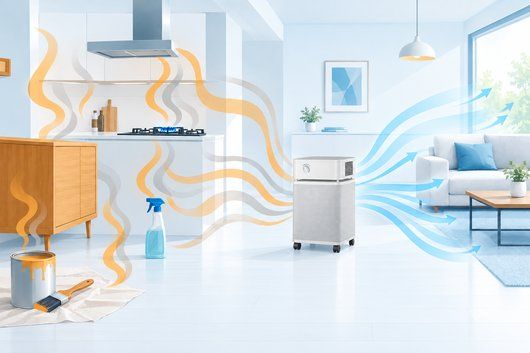 VOCs at home: what they are, where they hide and how to really remove themRead more: VOCs at home: what they are, where they hide and how to really remove them
Paint, new furniture, cleaning products and gas stoves release VOCs that no HEPA filter can stop. Discover where they...
-
 Extreme heat and air quality: what changes and how to protect yourselfRead more: Extreme heat and air quality: what changes and how to protect yourself
Extreme heat worsens the air quality we breathe, affecting everyone and especially people with MCS. Causes, updated...
-
 Asthma and Indoor Air Quality: What Science Says and How to Protect YourselfRead more: Asthma and Indoor Air Quality: What Science Says and How to Protect Yourself
Asthma affects millions of people and worsens at night, when exposure to bedroom allergens is highest. Clinical...
-
 Ten independent clinical trials on Austin Air: what they showRead more: Ten independent clinical trials on Austin Air: what they show
Eight published studies and two in progress, conducted by eight independent research institutions on asthma,...
-
 How to Recognize a Good Air Purifier and Avoid Marketing TricksRead more: How to Recognize a Good Air Purifier and Avoid Marketing Tricks
Inflated coverage, fake carbon, claims without tests: many purifiers only look great thanks to marketing. Here are...
-
 How to Choose the Right Austin Air Purifier for YouRead more: How to Choose the Right Austin Air Purifier for You
There is no single best air purifier, only the right one for your need. Let's see which Austin Air model to choose,...
-
 SAFA, iCleen Hepa, and Allermed air purifiers: what to do if yours is no longer in production or availableRead more: SAFA, iCleen Hepa, and Allermed air purifiers: what to do if yours is no longer in production or available
Do you have a air purifier SAFA, iCleen Hepa, or Allermed purifier that's discontinued or unavailable? Find out how...
Blog categories
Search in blog
Archived posts
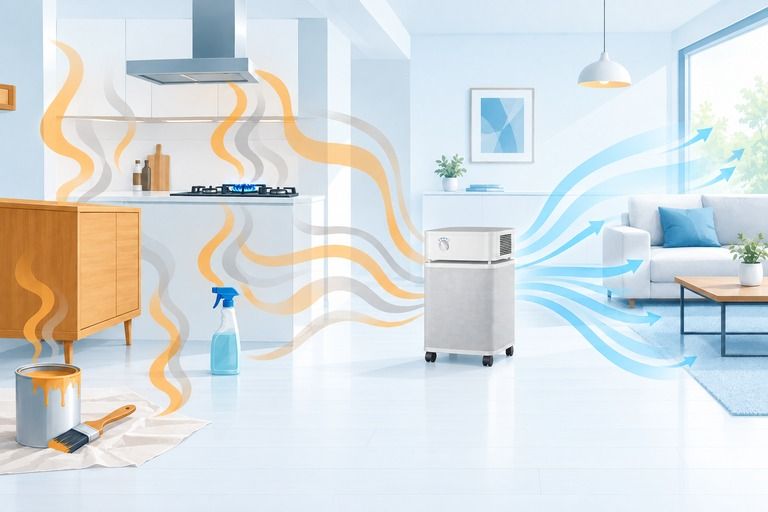
VOCs at home: what they are, where they hide and how to really remove them
Paint, new furniture, cleaning products, gas stoves: at home we breathe dozens of chemical compounds every day that no HEPA filter can stop. What VOCs are, why they're more concentrated indoors than outdoors, and what it really takes to reduce them.
Updated: • Reading: ~9 min
Many people assume an air purifier automatically removes odours, paint fumes and the substances released by new furniture. In reality, capturing dust and pollen and removing volatile organic compounds (VOCs) are two completely different problems that require different technologies. In this guide we look at where VOCs come from, what risks they carry, why most purifiers aren't designed to remove them, and how the Austin Air models built for chemical defence work.
What VOCs are
Volatile organic compounds are chemicals that evaporate easily at room temperature. Unlike dust and pollen, they aren't solid particles but gas molecules, often odourless, that spread freely through the air. Among the best known are formaldehyde, benzene, toluene, xylene, styrene and acetone.
According to the US EPA, concentrations of many VOCs are consistently higher indoors than outdoors, up to 10 times. During activities such as paint stripping, and for several hours afterwards, they can reach levels thousands of times higher than outdoors.
Where they hide at home
Sources include thousands of everyday products, which release VOCs both while in use and, to some extent, while simply stored at home.
Paints and finishes
Paints, varnishes, waxes and sealants contain organic solvents that keep releasing substances even after the surface looks dry.
Wood furniture and panels
Particleboard, MDF and resin furnishings are among the main sources of formaldehyde in homes.
Cleaners and fragrances
Cleaning products, disinfectants, sprays, air fresheners and scented candles release a real cocktail of compounds.
Renovations and new homes
Floors, adhesives, insulation and new furniture mean the highest concentrations are found precisely in new or newly renovated buildings.
Gas stoves and combustion
Besides VOCs, cooking with gas produces nitrogen dioxide (NO2): in homes with gas stoves, indoor levels often exceed outdoor ones.
Outdoor air and traffic
Exhaust fumes and urban pollutants enter through windows and ventilation and add to indoor sources.
Health effects
Effects depend on the compound, the concentration and the length of exposure. In the short term, the EPA reports eye, nose and throat irritation, headaches, dizziness and vision problems. Some VOCs, however, have far more serious long-term effects: benzene is a known carcinogen, and formaldehyde is classified by the International Agency for Research on Cancer (IARC) as a Group 1 carcinogen.
For formaldehyde in indoor environments, the World Health Organization sets a guideline value of 0.1 mg/m³ (30-minute average). In Italy, the National Institute of Health (ISS) contributed to the regulations governing formaldehyde release from materials used in furniture.
More sensitive people, such as those living with Multiple Chemical Sensitivity (MCS), may react even to concentrations others don't notice.
Why they increase in hot weather
VOC emissions depend heavily on temperature: the hotter it is, the faster paints, furnishings and materials release substances into the air, with significant seasonal differences. What's more, indoors VOCs can react with ozone to form aldehydes and secondary particulate. We covered this in our article on extreme heat and air quality.
Why a HEPA filter alone isn't enough
HEPA filters are designed to stop solid particles, not gases. Even the most efficient particulate filters work on particles far larger than a VOC molecule, which therefore passes straight through. A HEPA-only purifier can be excellent against fine dust and allergens, but does nothing about odours, chemical fumes and gases.
How VOCs are actually removed
Gases require gas-phase filtration, which relies on two mechanisms:
Adsorption
Gas molecules stick to the inner surface of a highly porous material, typically activated carbon. The more carbon there is and the longer the air stays in contact, the greater the capacity to trap VOCs.
Chemisorption
Treated (impregnated) materials react chemically with certain gases, turning them into more stable compounds. It's especially useful for reactive gases such as formaldehyde, which plain carbon struggles to hold.
Really reducing VOCs takes kilograms of activated carbon: filters with a thin veil of carbon saturate quickly and lose effectiveness.
Not all gases behave the same way
Traditional activated carbon works well on many VOCs and odours, but more reactive gases, such as formaldehyde, require impregnated media, specially treated to neutralise them chemically. That's why, when the goal is chemical defence, what matters is not only how much filter media there is, but which materials work together.
HealthMate Plus and Immunity Machine: Austin Air's chemical defence
All standard Austin Air models share the same foundation: a medical-grade HEPA filter with 5.6 m² of surface area (Hollingsworth & Vose filter media, grade HC-4011) and up to 6.8 kg of granular media combining activated carbon and zeolite. No thin carbon veil, then, but a filter mass designed to last up to 5 years.
How the air passes through the carbon matters too. Thanks to 360° air intake, in Austin Air purifiers the air enters from all sides and flows through a layer of carbon that completely surrounds the HEPA filter. Such a large passage area lets the air move through the filter media more slowly, and a longer contact time favours the adsorption of gases.
What changes between models is the type of materials used, and this is where HealthMate Plus and Immunity Machine stand out.


Combines, in a full 6.8 kg of granular media, activated carbon, potassium iodide-impregnated carbon and mineral-based filtration, for protection against VOCs, formaldehyde, benzene and other gases. The system is completed by two prefilters and a medical-grade HEPA filter with a surface area of a full 5.6 m².


The newest and most complete model in the range, with 8-phase filtration. At its core is a blend of four granular media (carbon, impregnated carbon, mineral-based filtration and impregnated mineral) that adsorbs odours, VOCs, formaldehyde, ammonia, nitrogen dioxide and other gases. The system is completed by two prefilters, medical-grade HEPA and military-grade HEGA carbon cloth.
For a full comparison of all models, see the comparison page or the buying guide.
What to avoid: technologies that can make air worse
Ozone generators
Ozone irritates the airways and, at levels considered acceptable indoors, removes little VOC. In fact, reacting with them it can generate aldehydes and secondary particulate.
Photocatalytic oxidation (PCO)
In theory it breaks VOCs down into carbon dioxide and water; in practice many systems produce harmful by-products, including formaldehyde itself.
Austin Air purifiers produce neither ozone nor ions. To spot other misleading claims, read our article on how to recognise a good air purifier.
Beyond the purifier: other good habits
Filtration works best alongside source control and ventilation:
- Choose water-based paints and low-VOC products
- Ventilate well during and after work, painting and assembling new furniture
- Store solvents, paints and chemicals in sealed containers, away from living areas
- Limit sprays, air fresheners and scented candles
- Always use the extractor hood when cooking with gas
How to tell if a purifier really removes VOCs
- Amount of carbon: measured in kilograms, not grams or thin layers
- Impregnated media for reactive gases such as formaldehyde
- Effective pre-filtration, which protects the carbon from clogging
- No ozone or by-product generation
- Real-world data, not just CADR: read why CADR isn't enough
- Correct sizing: use our air changes calculator
Conclusion
VOCs are among the most widespread and least visible pollutants in our homes. A purifier can genuinely reduce them only if it's designed for gas-phase filtration, with kilograms of activated carbon and specific media for the most difficult gases. HealthMate Plus combines activated carbon, impregnated carbon and mineral-based filtration for VOCs, formaldehyde and benzene; Immunity Machine, the most complete model in the range, combines four granular media, HEPA and HEGA cloth in an 8-phase system. To choose the right model for your situation, feel free to contact us directly.
 Contact us
 WhatsApp
Useful links
- Purifier buying guide
- Replacement filter guide
- Formaldehyde at home
- MCS and air purification
- Compare the Austin Air models
- Air changes calculator
- All Austin Air purifiers
- Contact us
Sources: US EPA, VOCs and indoor air quality; US EPA, indoor nitrogen dioxide; Italian National Institute of Health (ISS), formaldehyde exposure in homes (Italian); Italian Ministry of the Environment, chemicals bulletin (Italian); study on VOCs and interior finishes (ScienceDirect); official Austin Air Systems technical data. Note: performance may vary depending on conditions of use and maintenance. Air purifiers are not medical devices.
Posted in:
Air Quality Blog
Related posts
-
Asthma and Indoor Air Quality: What Science Says and How to Protect Yourself
Asthma affects millions of people and worsens at night, when exposure to bedroom allergens is highest. Clinical...Read more
-
Ten independent clinical trials on Austin Air: what they show
Eight published studies and two in progress, conducted by eight independent research institutions on asthma,...Read more
-
Air Purifiers: Complete Guide and How to Choose the Right One
How to choose the right air purifier: HEPA and carbon filters, sizing, noise, running costs and maintenance....Read more
-
Austin Air announces the launch of the Immunity Machine, its most advanced air purifier.
Austin Air introduces the Immunity Machine, its most advanced air purifier: 8-phase filtration with medical-grade...Read more
-
MCS and Air Purification: A Guide to More Livable Spaces
A practical guide to air purification for people with MCS and chemical sensitivity: how to choose the right purifier,...Read more
Leave a comment