Coconut shell or coal: two materials with different pores. Here is what the studies say and which works best with...

Latest posts
-
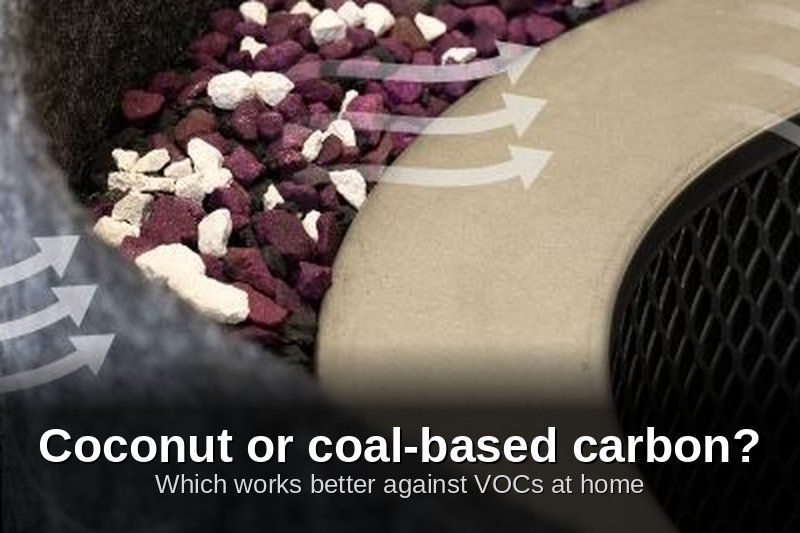 Coconut or coal-based carbon: which is better for VOCsRead more: Coconut or coal-based carbon: which is better for VOCs
-
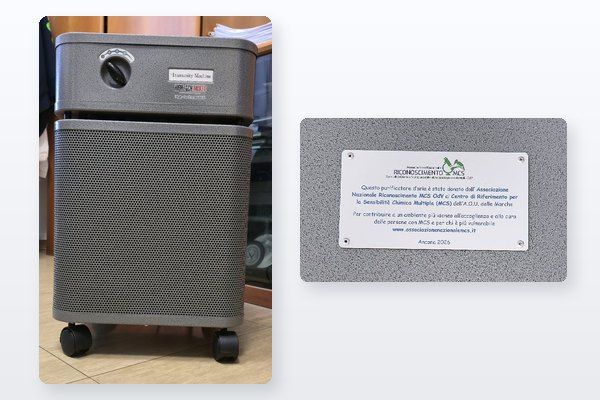 An air purifier donated to the MCS Reference Center in Ancona: a project made possible by the 5x1000Read more: An air purifier donated to the MCS Reference Center in Ancona: a project made possible by the 5x1000
The National Association for the Recognition of MCS donated an Austin Air Immunity Machine® air purifier to the MCS...
-
 Dog and cat odors at home: how to get rid of litter box ammonia tooRead more: Dog and cat odors at home: how to get rid of litter box ammonia too
The ammonia smell of the litter box, a wet dog's coat, hair and allergens everywhere: anyone living with dogs and...
-
 Saharan dust and Etna ash: what they are and how to protect the air at homeRead more: Saharan dust and Etna ash: what they are and how to protect the air at home
Yellow skies from African dust and falls of Etna ash: two increasingly frequent natural phenomena that bring fine...
-
 Floods and indoor air: what happens afterwards and how to protect yourselfRead more: Floods and indoor air: what happens afterwards and how to protect yourself
After a flood, the air problem does not end when the water recedes: mold, bacteria, dust and odors can linger at home...
-
 Austin Air announces the launch of the Immunity Machine, its most advanced air purifier.Read more: Austin Air announces the launch of the Immunity Machine, its most advanced air purifier.
Austin Air introduces the Immunity Machine, its most advanced air purifier: 8-phase filtration with medical-grade...
-
 MCS and Air Purification: A Guide to More Livable SpacesRead more: MCS and Air Purification: A Guide to More Livable Spaces
A practical guide to air purification for people with MCS and chemical sensitivity: how to choose the right purifier,...
-
 Air Purifiers: Complete Guide and How to Choose the Right OneRead more: Air Purifiers: Complete Guide and How to Choose the Right One
How to choose the right air purifier: HEPA and carbon filters, sizing, noise, running costs and maintenance....
-
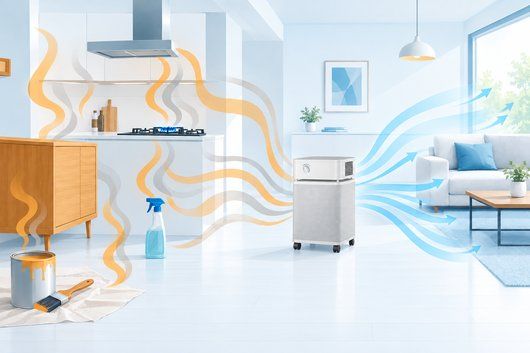 VOCs at home: what they are, where they hide and how to really remove themRead more: VOCs at home: what they are, where they hide and how to really remove them
Paint, new furniture, cleaning products and gas stoves release VOCs that no HEPA filter can stop. Discover where they...
-
 Extreme heat and air quality: what changes and how to protect yourselfRead more: Extreme heat and air quality: what changes and how to protect yourself
Extreme heat worsens the air quality we breathe, affecting everyone and especially people with MCS. Causes, updated...
Blog categories
Search in blog
Asthma and Indoor Air Quality: What Science Says and How to Protect Yourself
Why the air you breathe in the bedroom matters for people with asthma, what the clinical studies show, and how to choose the right air purifier.
Reading: ~9 min
Asthma: a daily problem for millions of people in Italy
Bronchial asthma is one of the most common chronic respiratory diseases in the world. In Italy it affects over 3 million people, around 5% of the adult population and up to 10% of children. It is a condition that never takes a holiday: people with asthma face it every day, often at night too, when symptoms tend to worsen.
Over 3 million people in Italy live with asthma: around 5% of adults and up to 10% of children.
Although it is widely studied and treated, asthma remains one of the leading causes of emergency room visits and of school and work absenteeism in Italy. And one of the most underestimated factors in controlling it is indoor air quality, especially in the bedroom.
What triggers asthma: indoor triggers
Asthma is a chronic inflammatory disease of the airways. It is not caused by a single agent, but by a combination of genetic and environmental factors. Triggers, the substances and conditions that set off or worsen symptoms, are often present in our homes without us realising it.
The main indoor asthma triggers are:
- Dust mites: their droppings and body fragments are among the most potent known allergens. They thrive in mattresses, pillows and carpets. Find out how to defend yourself against dust mites and allergens.
- Pet dander: dogs and cats continuously release microscopic, highly allergenic particles of dry skin.
- Mould spores: they spread through the air and irritate the airways, especially in damp environments.
- Cigarette smoke: even second-hand smoke is a powerful airway irritant and can trigger asthma attacks even in non-smokers.
- VOCs and chemicals: paints, detergents, air fresheners and building materials release volatile organic compounds that irritate sensitive airways. A typical case is formaldehyde in the home.
- PM2.5 and fine particles: the finest particles penetrate deep into the lungs and worsen bronchial inflammation.
- NO2 from gas cooking: recent studies have shown that cooking with gas significantly increases indoor nitrogen dioxide levels, a known respiratory irritant linked to asthma.
Why asthma gets worse at night
People with asthma know well that symptoms tend to worsen during the night and on waking. The phenomenon has a name, nocturnal asthma, and affects up to 75% of asthma patients.
There are several reasons:
- At night we lie still for hours a few centimetres from the mattress, continuously breathing in the allergens (dust mites and their droppings) found in the fibres
- Circadian rhythms influence the inflammatory response: at night bronchial inflammation tends to be more intense
- Cortisol production, which has a natural anti-inflammatory effect, reaches its lowest point during the night
- The horizontal position facilitates gastroesophageal reflux, which can worsen asthma symptoms
Reducing the concentration of allergens in the bedroom air means acting directly on one of the most critical moments for people with asthma.
What science says: the clinical studies with Austin Air
Austin Air has taken part in numerous independent clinical studies conducted by leading medical and academic institutions. Here we summarise those most closely related to asthma; the full list is in our article Ten independent clinical trials on Austin Air.
Cincinnati Children's Hospital: study on asthma in children
Austin Air's involvement in clinical trials began in 2001, when the company was selected by the American Academy of Pediatrics and Cincinnati Children's Hospital (one of the leading paediatric hospitals in the United States) for a study on the impact of air purification on children with asthma.
The Austin Air purifiers were used in the bedroom at night and in the living area during the day. Over twelve months, the results showed a significant reduction in asthma symptoms and a decrease in emergency room visits.
Johns Hopkins University: NO2 and asthma
A study conducted by Johns Hopkins University examined the impact of Austin Air purifiers in homes with gas cookers. The results showed a significant reduction in indoor NO2 levels and an improvement in respiratory symptoms in subjects with asthma and COPD.
University of Washington: reducing pollutants in children's bedrooms
A study conducted by the University of Washington measured the reduction of airborne pollutants in homes with asthmatic children.
-48% / -65% of airborne pollutants: the reduction measured respectively in common areas and in children's bedrooms.
UConn School of Medicine and Franklin W. Olin College
Further studies have observed positive effects also on systolic blood pressure in adults with elevated values who live near busy roads: in the UConn study, an average reduction of 2.8 mmHg after one month of filtration, an indirect effect of improved air quality.
In total, Austin Air has taken part in studies with: American Academy of Pediatrics, Cincinnati Children's Hospital, Johns Hopkins University, University of Washington, UConn School of Medicine and Franklin W. Olin College of Engineering.
How an air purifier works against asthma triggers
An air purifier that is effective for people with asthma must act on all the main indoor triggers, not just some of them:
 Medical-grade HEPA filter
Captures allergenic particles (dust mites, spores, dander, PM2.5) with an efficiency of 99.97% down to 0.3 microns and 99% down to 0.1 microns.
 Activated carbon
Traps VOCs, smoke, NO2 and chemical odours that irritate the airways and that a HEPA filter alone does not trap.
Continuous, quiet operation
Must be able to run all night without disturbing sleep, precisely during the hours when asthma is worse.
Adequate air flow
Must be sized for the room where it is used. You can check this with the air changes calculator.
In practice: a purifier with HEPA alone does not capture gases and VOCs, one with carbon alone does not capture particles. You need the combination of both, and in sufficient quantity.
 The solution: Austin Air Bedroom Machine®

The Austin Air Bedroom Machine® was designed specifically for night-time use in the bedroom, the most critical time for people with asthma.
Medical-grade HEPA, 5.6 m², for allergens
The medical-grade HEPA filter captures 99.97% of particles down to 0.3 microns and 99% down to 0.1 microns: dust mites, mould spores, pet dander, pollen and PM2.5. Thanks to the 360° intake, room air enters the filter from all sides.
Activated carbon and zeolite for gases and VOCs
The layer of non-impregnated coconut shell activated carbon and zeolite traps VOCs, smoke and chemical odours, the gaseous triggers that a HEPA filter alone cannot capture.
HEGA filter: military technology for the bedroom
The Bedroom Machine includes the HEGA filter (High Efficiency Gas Adsorption), a carbon cloth developed by the British Armed Forces as protection against chemical agents and gases, placed as the last stage before the air exits. Austin Air is one of the very few manufacturers to integrate this technology into a portable home air purifier.
Quiet operation for undisturbed sleep
At low speed the measured noise level is about 40 dB(A) at 1 metre: the purifier can work all night without disturbing sleep.
Low-emission construction
High-temperature powder-coated steel housing, unpainted motor and plastic limited to the fan blade, wheels and knob: materials chosen to keep emissions from the device itself to a minimum. An important detail for those with particularly sensitive airways.
If you cook with gas or live in a high-traffic area, also consider the HealthMate Plus, with part of the carbon impregnated with potassium iodide, more effective on NO2 and formaldehyde. Not sure which model is right for you? Use the buying guide or compare all Austin Air models.
Conclusion: the air you breathe at night makes the difference
Asthma is a chronic condition that is managed, not eliminated, and the quality of the air you breathe every night is one of the environmental factors that can influence symptoms. The clinical studies carried out with major American medical institutions have observed positive results with home air purification.
Protecting the bedroom air with a high-efficiency purifier does not replace medical treatment, but it is a concrete environmental measure to reduce exposure to asthma triggers during the most vulnerable hours of the day.
Discover the Austin Air Bedroom Machine® on high-techmarket.it, authorized Austin Air importer for Italy.
Useful links
 Austin Air purifier buying guide
 Replacement filters guide
 Compare the Austin Air models
 Air changes calculator
 Purifiers for people with chemical sensitivity (MCS)
- Austin Air Bedroom Machine® product page
 Ten independent clinical trials on Austin Air
- Dust mites, pollen and allergens in the bedroom
- Mould at home: risks and how to protect your air
 All Austin Air purifiers
 Contact us
Note: air purifiers are not medical devices and do not replace medical treatment or advice. Efficacy claims refer to independent studies and/or laboratory tests; performance may vary depending on use, the substances present and individual sensitivity.
Posted in:
Air Quality Blog
Related posts
-
 Ten independent clinical trials on Austin Air: what they show
Eight published studies and two in progress, conducted by eight independent research institutions on asthma,...Read more
-
Air Purifiers: Complete Guide and How to Choose the Right One
How to choose the right air purifier: HEPA and carbon filters, sizing, noise, running costs and maintenance....Read more
-
Austin Air announces the launch of the Immunity Machine, its most advanced air purifier.
Austin Air introduces the Immunity Machine, its most advanced air purifier: 8-phase filtration with medical-grade...Read more
-
MCS and Air Purification: A Guide to More Livable Spaces
A practical guide to air purification for people with MCS and chemical sensitivity: how to choose the right purifier,...Read more
-
 Wildfires and Air Quality: Health Risks and Indoor Air Protection
Wildfires are no longer seasonal events. Learn how wildfire smoke affects respiratory and systemic health, what it...Read more
Leave a comment