
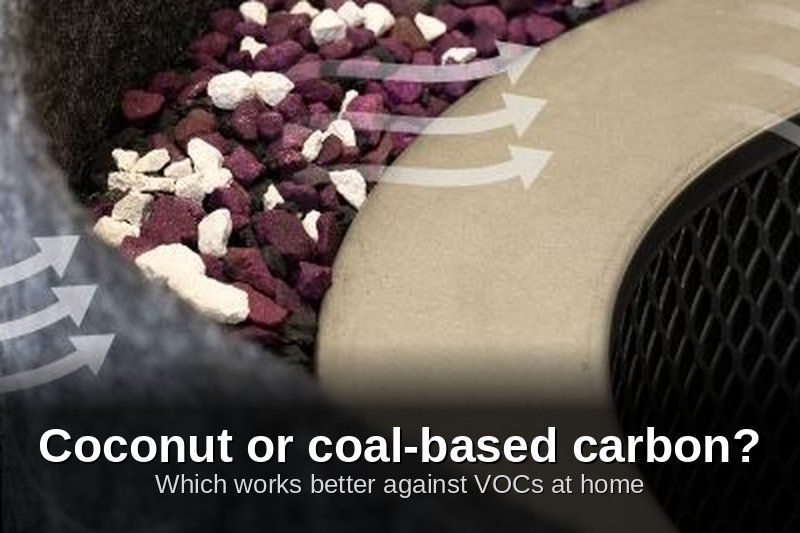
Coconut shell or coal: two materials with different pores. Here is what the studies say and which works best with...
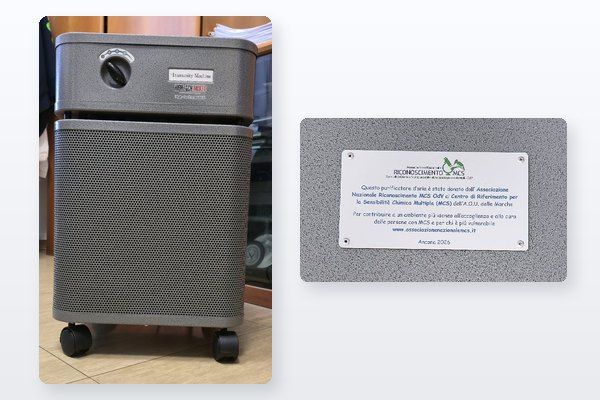



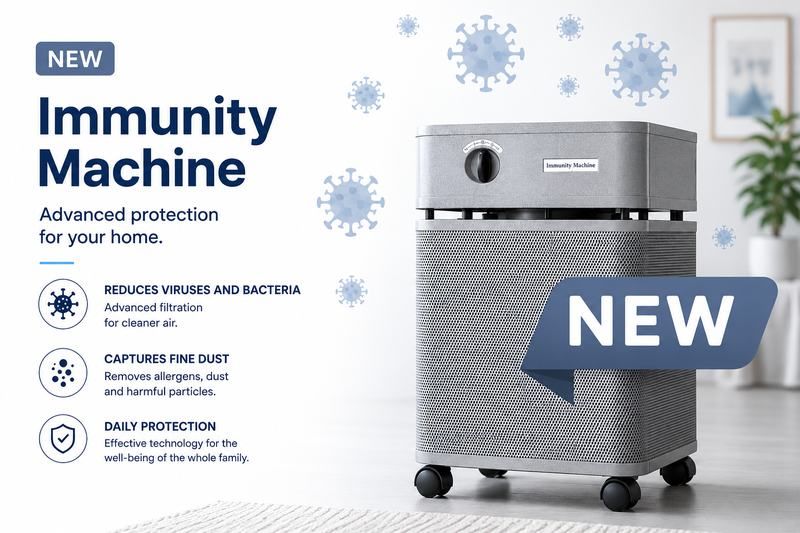

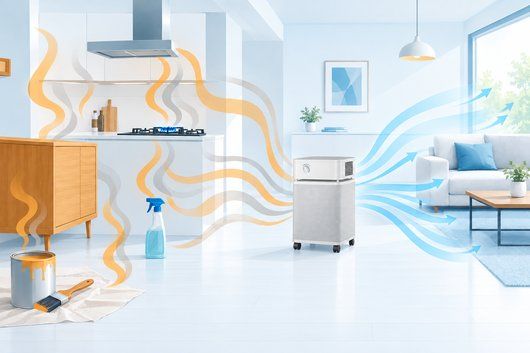

Reduce odors and VOCs, choose the right purifier, set it up properly, manage floor and furniture off-gassing, and avoid the most common mistakes.
Read time: ~8 min
This is a practical guide: how to choose, how to set up the unit, and how to handle critical situations. If you are looking for the services we offer to people with MCS (degassing, dedicated preparation, support), go to our Dedicated MCS Services page.
What people with MCS report
Multiple Chemical Sensitivity is described by many people as a hypersensitivity not only to odors and VOCs but sometimes also to sensory stimuli such as bright lights or noise. Cumulative exposure to everyday chemicals can make it difficult to tolerate even very low doses, and avoidance of irritating substances often remains the most effective strategy.
In Italy, recognition challenges and limited access to dedicated healthcare pathways persist: many people rely on associations and peer networks for guidance and information sharing. Some of these associations are listed at the bottom of this page.
Why an air purifier can help
 Fine particles
Medical-grade HEPA filters capture fine dust, pollen, spores, and other airborne allergens.
 Odors and VOCs
You need gas-phase filtration with a substantial amount of activated carbon: paints, adhesives, new furnishings, solvents, fragrances, formaldehyde.
 Fewer exposure spikes
Purifying the rooms where you spend the most time, the bedroom above all, helps limit exposure spikes to triggers.
How to choose a suitable purifier
- Complete filtration: HEPA for particles plus activated carbon for gases and odors. Not all purifiers address VOCs.
- Inert materials: avoid low-quality units and filters that may themselves emit odors and irritating VOCs.
- No ozone and no ionization: rule out technologies that generate ozone or unwanted by-products.
- Adequate airflow: enough airflow to deliver multiple air changes per hour, with a reliable motor for continuous operation and low power draw.
- Warranty and support: prefer suppliers able to offer a direct warranty and assistance before and after purchase.
Why many people choose Austin Air
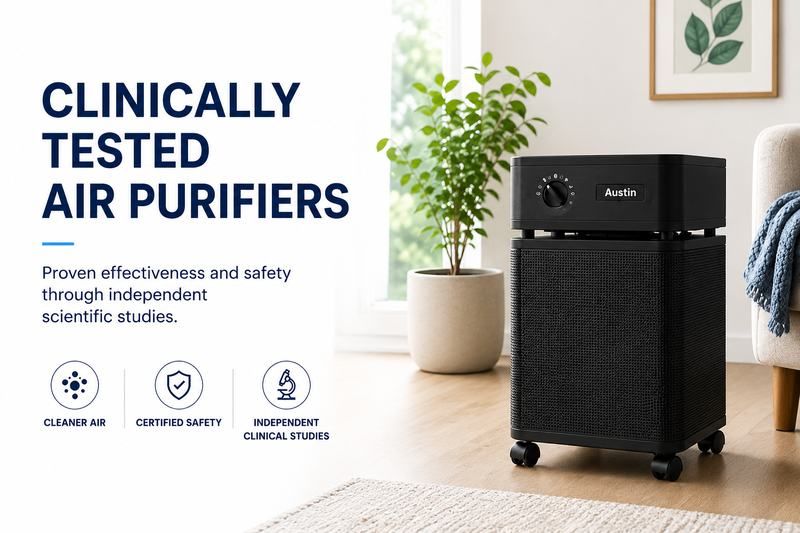
Austin Air purifiers combine a medical-grade HEPA filter with a large bed of coconut shell activated carbon, rich in micropores, and zeolite, up to 6.8 kg in standard models, inside a hand-welded steel body with a high-temperature baked powder coating that does not release odors. The motor is unpainted and filters have an expected life of up to 5 years in home use. The 360° intake draws air in from all sides: it passes more slowly through the layer of carbon surrounding the HEPA, with a longer contact time that favours the adsorption of odors and VOCs.
The point that matters most if you have MCS
All standard models contain the same amount of carbon and zeolite. The difference is not the quantity but the type of material.
With carbon impregnated with potassium iodide (KI): HealthMate Plus, HealthMate Plus Junior, and Immunity Machine. Impregnation increases capacity on formaldehyde and volatile chemical compounds.
With non-impregnated carbon and zeolite: HealthMate, HealthMate Junior, and Bedroom Machine. The latter adds HEGA cloth, which is not impregnated with KI.
Models with impregnated media are also used regularly by a growing number of people with MCS; for those who prefer non-impregnated media, the alternatives are the HealthMate, Bedroom Machine and HealthMate Junior.
Which model, in which situation
Non-impregnated carbon and zeolite: acts on particulate and on a wide range of odors and VOCs. The choice for those who prefer non-impregnated media.
Carbon impregnated with KI: greater capacity on strong odors, VOCs, and aldehydes such as formaldehyde. Useful after renovations or with new furnishings.
Non-impregnated carbon and zeolite, plus a fifth stage with military-grade HEGA cloth: greater capacity on gases and VOCs, without KI-impregnated media.
Compact format for a desk or bedside table, with medical-grade HEPA and an optional VOC Carbon Wrap for odors and VOCs (lasting about 3 months).
Typical scenarios
- After renovations or painting: HealthMate Plus in the living room, continuous operation for 24-72 hours, then low or medium-low speed for maintenance.
- New furnishings or mattresses: place the unit near the odor source without pushing it against it, with the door ajar to promote air exchange.
- Bedroom: Bedroom Machine or HealthMate, running continuously during sleep.
- Home office: HealthMate as a balanced choice, with boost cycles when needed.
Correct activation: the 7-day procedure
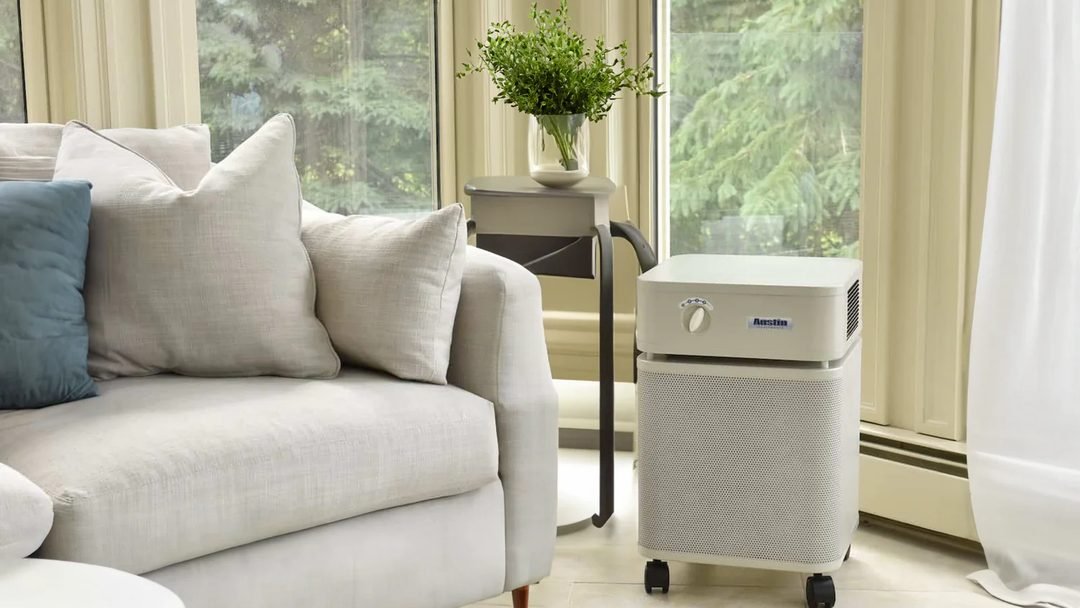
Placement (from the Austin Air owner's manual): place the unit on the floor, on a flat, stable surface, at least 10 cm (4 inches) from the wall, with the air vent facing away from the wall. The Austin “it” should instead be placed on a table or bedside table.
First start: the manual advises running the unit at high speed for at least one hour, then switching to the desired setting.
- Day 1: place the unit as described above and run at high speed for 1-3 hours.
- Days 2-3: continuous use at low or medium-low speed in the priority area.
- Day 4: check perceived odors. If they persist, run boost sessions at high speed for 30-60 minutes.
- Days 5-7: stabilization. Keep low or medium-low speed, with boosts only when needed (cleaning, guests, strong odors).
- Always: a brief daily airing helps dilute indoor VOCs.
How to manage floor and furniture off-gassing
Off-gassing is the gradual release of VOCs and odors from new materials: vinyl and laminate flooring, varnished parquet, particleboard and MDF, glues, paints, upholstered furniture. It is one of the most critical situations for people with MCS, but it is also temporary and manageable. Here is an eight-step plan.
- Upfront choices: prefer low-emission products, paints, and adhesives, asking for technical data sheets.
- Seasoning: let materials rest in a separate, ventilated room before moving them into the main rooms.
- Cross-ventilation: in the first days, air out frequently, without odor-masking fragrances.
- Continuous purification: run the purifier 24/7 at low or medium-low speed, with 30-60 minute boosts when odor increases.
- Placement: in the first 72 hours keep the unit in the affected room, always at least 10 cm from walls and furniture.
- Gentle cleaning: remove dust with slightly damp microfiber cloths, avoiding scented cleaners.
- Indoor climate: high temperature and humidity accelerate release. Keep conditions moderate.
- Monitoring: after 2-4 weeks assess the reduction in odor and, if needed, continue with steady use and regular airing.
Off-gassing naturally decreases over time: the purifier and ventilation are there to manage the initial period, the one with the most intense emissions.
Common mistakes to avoid
- Confusing HEPA and VOCs: a HEPA filter does not remove gases. For odors and VOCs you need carbon or zeolite in quantity.
- "Thin" carbon: light impregnated sheets have limited effectiveness. What counts is the mass and the contact time with the air.
- Ozonizers and ionizers: avoid them, they produce ozone or unwanted by-products.
- Intermittent use: continuous low-speed operation with targeted boosts works better.
- Masking fragrances: air fresheners and scented candles hide the odor but add VOCs. Prefer airing and filtration.
Maintenance
- Once a month: gently vacuum the outside of the pre-filter, without removing it, using the soft brush attachment (more often if you have pets).
- Every 3-6 months: reassess odors and performance, with short high-speed cycles if needed.
- Based on use: replace the filter pack when capacity on odors and VOCs declines noticeably. In home environments the expected life reaches up to 5 years.
Original replacements are in the replacement filters section; to work out which one your model needs, see the filters guide.
Our services for people with MCS
On request we offer degassing of the purifier before delivery: 7 days as standard, free of charge, extendable on request without limits. Alongside this we provide dedicated packaging preparation and personalised assistance.
Full details, including how to request them, are on our Dedicated services for people with Multiple Chemical Sensitivity page.
 Contact us
 WhatsApp
Partners and associations



We collaborate with the AMICA Association, the National Association for MCS Recognition, the Committee beyond MCS, and the Tuscan MCS Committee. Contact the associations to learn about the benefits reserved for members.
Useful links
 Dedicated services for people with MCS
 Austin Air air purifier buying guide
 Austin Air replacement filters guide
 Austin Air model comparison
 Air exchange calculator
 We are authorized Austin Air importers for Italy
 All Austin Air purifiers
- Replacement filters
Note: air purifiers are not medical devices and do not replace medical advice. Effectiveness depends on use, on the substances present, and on individual sensitivity. Placement and first-start information is taken from the Austin Air owner's manual.

Leave a comment