
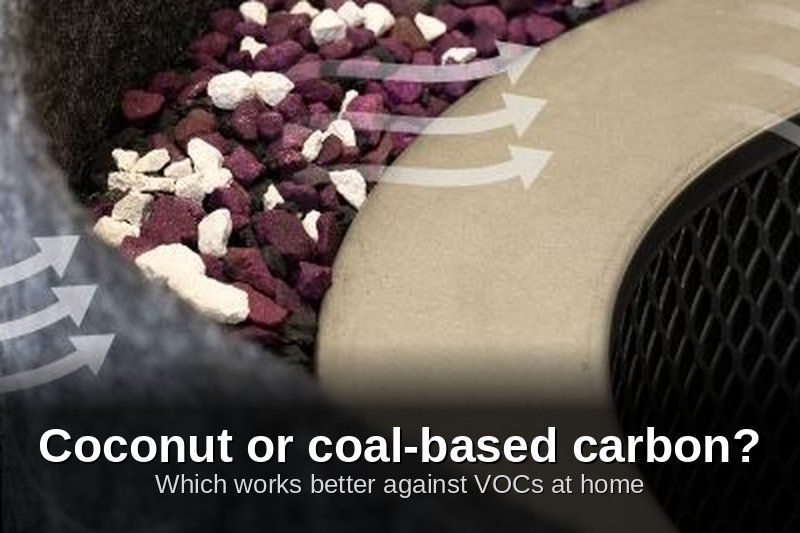
Coconut shell or coal: two materials with different pores. Here is what the studies say and which works best with...

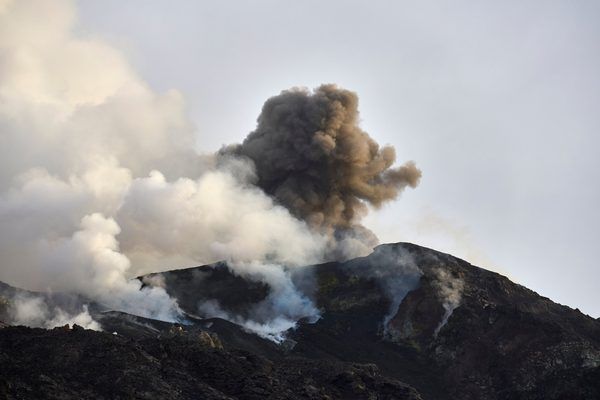



What wildfire smoke contains and how it affects the body, from the lungs to the nervous system.
Read time: ~8 min
Looking for what to do right now? This article explains what is in the smoke and how it acts on the body. If you need immediate practical guidance instead (symptoms to watch for, what to do and what to avoid, how to set up a clean room), go to our practical guide to protecting the air in your home.
Wildfires are one of the most significant environmental and public health emergencies of recent years, and they are no longer isolated or strictly seasonal events. As Austin Air observes in its dedicated ebook, the very concept of a "wildfire season" has become outdated: we now speak of wildfire years, with fires that are more frequent, more intense, and longer lasting.
The consequences extend far beyond the destruction of forests and homes. Smoke compromises air quality on a large scale and poses a concrete threat to respiratory, cardiovascular, and systemic health, even at great distances from the fire itself.
This article is an informational adaptation of the Austin Air ebook "Wildfires: Your guide to preserving respiratory health".
A real story: when returning home depends on the air
The Austin Air ebook recounts the story of a family forced to evacuate their home because of a devastating wildfire. After weeks away, the problem on their return was no longer the fire: it was the air.
Smoke had permeated walls, furniture, fabrics, and surfaces. It was not the familiar smell of burning wood, but a residual mixture produced by the combustion of homes, vehicles, plastics, and chemical materials.
To protect their children's health, the family adopted a precise plan: air purifiers running throughout the house, 24 hours a day. According to the account, it was continuous indoor air filtration that made the decision to move back in possible.
This episode brings into focus something often overlooked: after a fire, indoor air quality can become the factor that determines whether a home is livable again.
What wildfire smoke really contains
Wildfire smoke is the result of incomplete combustion, a process that generates a mixture far more complex than simple wood smoke. According to the Austin Air ebook, it may contain particulate matter in three size classes, toxic gases, volatile organic compounds, heavy metals, and airborne biological contaminants.
Particulate matter
Three size classes: PM10, PM2.5, and PM0.1. This is the most studied and most dangerous component.
Gases and VOCs
Nitrogen oxides, sulfur dioxide, ozone, and volatile organic compounds released by combustion.
Metals and biologicals
Heavy metals released by burning materials, alongside airborne fungi, bacteria, and microbes.
When wildfires reach urban or industrial areas, toxicity increases further: synthetic materials, paints, fuels, and furnishings burn, releasing substances absent from a purely forest fire.
PM10, PM2.5, and PM0.1: why size matters
Particulate matter is the most dangerous component of smoke, and its danger increases as particle size decreases: the smaller the particles, the deeper they penetrate the body.
PM10
Relatively large particles. They are mostly stopped in the upper airways, where they irritate the eyes, nose, and throat.
PM2.5
Fine particles invisible to the naked eye, able to reach the deep regions of the lung and pass into the bloodstream.
PM0.1
Ultrafine particles, able according to the cited studies to cross cell membranes and distribute to other organs.
Many of these particles are smaller than bacteria and viruses and are not intercepted by the body's natural respiratory defenses: neither nasal hair nor airway mucus can retain them.
Effects on the body
Respiratory system
The first target. Smoke exposure is associated with persistent coughing, shortness of breath, airway irritation, worsening of asthma and COPD, and reduced lung function. Studies cited in the ebook show a significant increase in hospital admissions for respiratory conditions during periods of heavy exposure.
Immune system
A less known but documented impact. According to the literature referenced in the ebook, ultrafine particles may interfere with the activity of macrophages, cells central to the immune response, contributing to prolonged inflammatory states and a reduced ability to fight infection.
Nervous system
The cited studies associate prolonged exposure to ultrafine particulate with inflammatory processes at the neurological level, and hypothesize a correlation with cognitive decline and neurodegenerative conditions. This is a field of research still evolving: associations observed in epidemiological studies do not amount to a demonstrated cause-and-effect relationship.
Cardiovascular system
Fine particulate that reaches the bloodstream is associated with increased cardiovascular stress, which is why people with heart conditions are among the most sensitive groups during smoke episodes.
Smoke travels: where you live matters too
Wildfire smoke can travel hundreds or thousands of kilometres, but its effects depend greatly on distance.
Relatively nearby fires, such as those that hit the Mediterranean, southern Italy and the islands, Greece or Portugal every summer, can noticeably worsen ground-level air quality even tens or hundreds of kilometres from the flames, when winds push the smoke towards populated areas. During transport, particles interact with other pollutants, and in some cases the resulting mixture becomes more aggressive than the original.
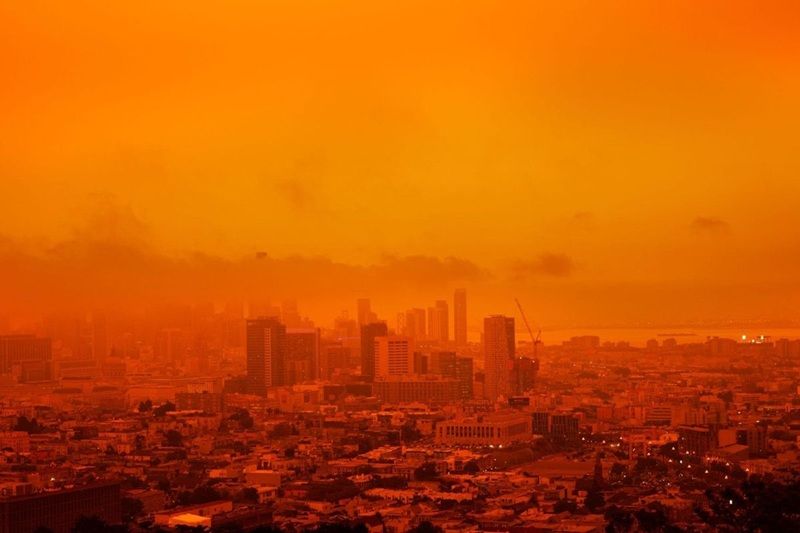
Smoke from very distant fires also reaches Europe: the European Copernicus service has documented several times, for example in 2023 and 2025, plumes of smoke from Canadian wildfires crossing the Atlantic. In these cases, however, the smoke usually travels at high altitude: skies look hazy and sunsets turn red-orange, but according to Copernicus the impact on the air we breathe at ground level is generally limited.
For how to notice it, even when the sky looks clear, and which indices to check daily, you will find practical guidance in the practical guide.
After the fire: why the air stays contaminated
Even once the flames are out, the risk does not end. Toxic particles settle on surfaces, fabrics, and materials, and cleanup and remediation work can resuspend them, creating fresh exposure days or weeks after the event.
This is why the story told at the beginning was not about the flames, but about the return: the phase following a fire carries its own specific hazard, and calls for care in how spaces are cleaned and for continuous air filtration.
Why indoor filtration is decisive
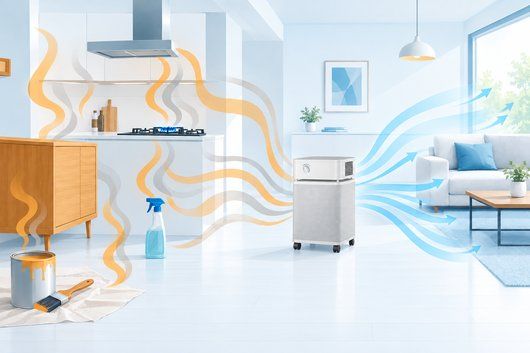
Not all purifiers can handle wildfire smoke, for a precise reason: smoke is particles and chemicals together. A filter that acts only on particulate lets the gaseous component through, the part responsible for odors and much of the irritation.
What is needed is the combination of pre-filters, medical-grade HEPA, and a substantial mass of activated carbon and zeolite. Austin Air purifiers are designed around this principle, with up to 6.8 kg of adsorbent material per filter in standard models.
For model comparisons and selection criteria, see the buying guide, the comparison page, and the practical smoke guide, where the models best suited to this situation are described in detail.
Schools, families, and workplaces
Children, teachers, and workers spend many hours indoors, often with no control over the quality of the air circulating there. On smoke days this can make a substantial difference, because the indoor environment becomes the only space where it is possible to act on the air being breathed.
Children are among the most exposed: they breathe a greater volume of air relative to body weight and their respiratory system is still developing. Along with older adults, pregnant women, and people with respiratory or cardiac conditions, they are among the groups first affected by deteriorating air.
In summary
- Wildfire smoke is a complex mixture, not simple soot: particulate, gases, VOCs, metals, and biological contaminants.
- Danger increases as particle size decreases: ultrafine particles reach organs far from the lungs.
- Documented effects involve the respiratory and cardiovascular systems, the immune system, and, according to research still evolving, the nervous system.
- Smoke travels long distances and contamination persists after the fire.
- Effective defense requires HEPA and activated carbon together, running continuously.
Wildfires are no longer a temporary emergency but an ongoing reality. Protecting indoor air quality has become a concrete preventive measure, within anyone's reach.
As authorized Austin Air importers for Italy, we at High-Tech Market believe that product distribution should go hand in hand with accurate, verifiable, and transparent information on air quality.
 WhatsApp
Useful links
 Wildfire smoke: the practical guide to protecting the air in your home
 Austin Air air purifier buying guide
 Austin Air model comparison
 Air exchange calculator
- Fireplaces and wood stoves: PM2.5 and indoor air
 All Austin Air purifiers
 Replacement filters
 Contact us
Note: this article is for general information only and does not replace medical advice or the guidance of health authorities. Statements refer to studies cited in the Austin Air ebook and to the scientific literature on particulate exposure; epidemiological studies show associations that do not amount to demonstrated cause-and-effect relationships. Air purifiers are not medical devices.
Informational adaptation of the ebook "Wildfires: Your guide to preserving respiratory health", Austin Air Systems. Copyright © Austin Air Systems. All trademarks, names, and original content belong to their respective owners.
Source for long-range smoke transport: Copernicus Atmosphere Monitoring Service (CAMS), releases on Canadian wildfire smoke reaching Europe, June 2023 and June 2025.
Leave a comment