In winter we spend almost all our time indoors with the windows closed. Ventilation removes CO₂ and humidity, while...

Latest posts
-
 Closed windows in winter: ventilation and air purifier, the right pair for your indoor airRead more: Closed windows in winter: ventilation and air purifier, the right pair for your indoor air
-
 Renovation and indoor air: dust, paint and VOCs, how to protect yourself during and after the workRead more: Renovation and indoor air: dust, paint and VOCs, how to protect yourself during and after the work
A renovation changes the air at home twice: during the work because of dust, afterwards because of VOCs from paint,...
-
 Gas stoves and indoor air: nitrogen dioxide, benzene and how to protect yourselfRead more: Gas stoves and indoor air: nitrogen dioxide, benzene and how to protect yourself
In Italy more than half of all homes cook with gas. Studies show that the flame releases nitrogen dioxide, benzene...
-
 Scented candles, incense and diffusers: what they release into your indoor airRead more: Scented candles, incense and diffusers: what they release into your indoor air
Candles, incense, wax melts and diffusers make the holiday atmosphere warmer, but they release particles,...
-
 Microplastics and nanoplastics in indoor air: what they are, how many we breathe and how to reduce themRead more: Microplastics and nanoplastics in indoor air: what they are, how many we breathe and how to reduce them
Microplastics are also in the air at home, far more than was thought. What micro- and nanoplastics are, where...
-
 HEGA cloth: what military-grade activated carbon does in Austin Air filtersRead more: HEGA cloth: what military-grade activated carbon does in Austin Air filters
HEGA cloth is the military-grade activated carbon in the Bedroom Machine and Immunity Machine filters. What it is,...
-
 A gift you can breathe: Austin Air ideas for your loved ones (and for you)Read more: A gift you can breathe: Austin Air ideas for your loved ones (and for you)
Some gifts end up in a drawer, others work every day, quietly, for many years. Here is which Austin Air purifier to...
-
 Coconut or coal-based carbon: which is better for VOCsRead more: Coconut or coal-based carbon: which is better for VOCs
Coconut shell or coal: two materials with different pores. Here is what the studies say and which works best with...
-
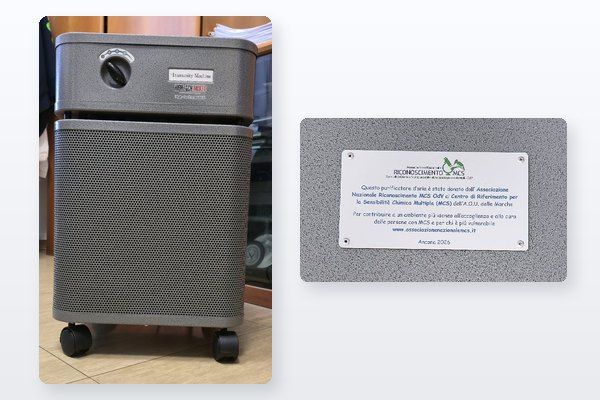 An air purifier donated to the MCS Reference Center in Ancona: a project made possible by the 5x1000Read more: An air purifier donated to the MCS Reference Center in Ancona: a project made possible by the 5x1000
The National Association for the Recognition of MCS donated an Austin Air Immunity Machine® air purifier to the MCS...
-
 Dog and cat odors at home: how to get rid of litter box ammonia tooRead more: Dog and cat odors at home: how to get rid of litter box ammonia too
The ammonia smell of the litter box, a wet dog's coat, hair and allergens everywhere: anyone living with dogs and...
Blog categories
Search in blog

Renovation and indoor air: dust, paint and VOCs, how to protect yourself during and after the work
A renovation changes the air at home twice: during the work, because of the dust raised by demolition, cutting and sanding, and afterwards, because of the substances that new paint, adhesives, flooring and furniture keep releasing for weeks.
In this article we look at what studies say about dust and VOCs at each stage of the work, what to watch out for in older homes and how to protect the people who live there, including when to use the air purifier and when it is better to wait.
During the work: dust
Knocking down a wall, cutting tiles, drilling or sanding filler and plasterboard raises large amounts of fine dust, including the crystalline silica found in mortar, concrete and bricks.
A Norwegian study published in 2024 in Annals of Work Exposures and Health measured the dust breathed by workers at 14 indoor renovation sites around Oslo, with more than 400 samples. Average levels were already significant, but the peaks were dozens of times higher: up to 29 mg/m³ of respirable dust and 3.2 mg/m³ of respirable crystalline silica. The measurements concern workers, but they give a clear idea of how much dust is raised in a room during the heaviest stages.
Seal off the work area
Plastic sheeting over openings and furniture, doors kept closed and, if possible, a single route through to the rest of the home.
Clean without raising dust
No dry sweeping: use damp cloths and a vacuum cleaner with a HEPA filter, every day and at the end of the work.
Protect the most sensitive
Keep children, older people and anyone with asthma or chemical sensitivity away from the work area, especially during demolition and sanding.
Older homes: watch out for asbestos and lead
In homes built some decades ago, it is worth knowing what materials you are dealing with before demolishing or sanding.
Asbestos
In Italy asbestos has been banned by Law 257/1992, but it is still present in many buildings. Vinyl-asbestos floor tiles, for example, were used mainly between 1960 and 1980. When intact they are considered low risk, but cutting, drilling or abrading them can release large quantities of fibres into the air.
Lead in old paint
Old paints could contain lead. The U.S. Environmental Protection Agency (EPA) advises having them tested before the work and, in any case, wetting surfaces before sanding, scraping or drilling, and cleaning with a HEPA vacuum.
If in doubt: before working on floors, coverings or paints whose composition you do not know, have the materials assessed by a professional. No air purifier offers adequate protection against asbestos or lead.
After the work: VOCs from paint, adhesives, flooring and furniture
Once the dust is gone, another stage begins. Paints, fillers, adhesives, sealants, flooring, panels and new furniture release volatile organic compounds (VOCs), including formaldehyde, especially in the first few weeks.
A German study published in 2012 (Herbarth and Matysik), also based on measurements in 243 homes, found VOCs particularly high right after the work and estimated that it takes on average 2 to 8 weeks for concentrations to fall below guideline values, depending on the value considered. The authors propose a waiting period before rooms are used again, starting with nurseries and kindergartens.
Tests by Lawrence Berkeley National Laboratory on paint, carpet and vinyl flooring add two useful points: intensive ventilation reduces VOCs only while it lasts, and airing materials before installation worked for carpet, but not for vinyl.
How to protect the air at home
Plan the timing
If you can, do the work before moving back in and leave a few weeks between the end of the work and using the rooms.
Children's room first
Bedrooms, especially the children's room, should be finished first so they have more time to air out.
Low-emission materials
Choose paints, adhesives and finishes with low VOC emissions and ask for the products' technical data sheets.
Ventilate for weeks
After paint, flooring and furniture go in, open the windows often, not just for the first few days: emissions last longer.
Thorough final clean
At the end of the work, use a HEPA vacuum and damp cloths on floors, shelves, skirting boards and fabrics, where fine dust settles.
Air purifier at the right stage
In the rooms you live in during the work and, in the renovated room, from painting and flooring onwards: see the advice below.
Using an air purifier during and after the work
An air purifier does not replace sealing off the work area, cleaning and ventilation, but it is a real help if you use it at the right stage.
Demolition and building work
In the room being worked on it is better not to use it: there is too much construction dust and it would clog the pre-filter straight away. Use it instead in the nearby rooms, if they are lived in and not affected by the work, or wait until the dusty stage is over.
Painting, flooring and finishes
During painting, wallpapering, laying laminate, vinyl or wood flooring and finishing you can use it in the renovated room too: this is when paints, adhesives and new materials start releasing VOCs.
- Residual fine dust: the medical-grade HEPA filter in Austin Air purifiers captures 99.97% of particles at 0.3 µm and 99% at 0.1 µm (official Austin Air data).
- VOCs and formaldehyde: the bed of coconut shell activated carbon and zeolite (up to 6.8 kg in the standard models) adsorbs gases, odours and VOCs. In the HealthMate Plus and the Immunity Machine, part of the carbon is impregnated with potassium iodide, which is more effective on formaldehyde.
- Pre-filter: during this period it should be vacuumed more often than usual, depending on how much dust there is in the room. This protects the main filter and keeps the airflow steady.
Which Austin Air model to choose

HealthMate Plus
The typical choice for those living in a new or recently renovated home: part of the carbon is impregnated with potassium iodide, for a more targeted action on formaldehyde and other VOCs.

Immunity Machine
The most complete: potassium iodide impregnated carbon, mineral filtration and HEGA carbon cloth. For people with heightened immune vulnerability or who want the strongest action on gases.

Bedroom Machine
For a newly renovated bedroom, with new furniture, flooring or mattress: in addition to carbon and zeolite it adds HEGA carbon cloth, with no impregnated materials.

HealthMate
For the rooms you live in during the work and for fine dust and odours: medical-grade HEPA and up to 6.8 kg of non-impregnated activated carbon and zeolite.
Models with impregnated materials (HealthMate Plus and Immunity Machine) are also used regularly by a growing number of people with MCS. For those who prefer non-impregnated materials, the alternatives are the HealthMate, Bedroom Machine and HealthMate Junior.
Frequently asked questions
How long should I wait before sleeping in a freshly painted room?
There is no single answer: it depends on the products used, the room and how well it is aired. The Herbarth and Matysik study indicates on average 2 to 8 weeks for VOCs to fall below guideline values after the work. That is why it is best to finish bedrooms first, air them often and, for children, wait as long as possible. If waiting is not possible, always air the rooms and keep the air purifier running continuously, especially at night.
Are "low-emission" paints enough?
They help a lot, but they are only one of the sources: adhesives, sealants, flooring, panels and furniture also release VOCs. Even with low-emission products, it is important to ventilate for a long time after the work.
Should the air purifier be on during the dustiest work too?
During demolition and building work it is better not to use it in the room being worked on: use it in the nearby rooms, if they are lived in and not affected by the work, or wait until the dusty stage is over. During painting, flooring (laminate, vinyl, wood) and finishing it can be used in the renovated room too. In any case, the pre-filter should be vacuumed more often during this period.
Useful links
- Formaldehyde at home: health risks and the air purifier
- VOCs at home: where they come from and how to reduce them with activated carbon
- Air purifier for allergies and asthma: protecting the air in your bedroom
- Mold at home: types, health risks and how to protect the air you breathe
- Austin Air air purifier buying guide
Sources
- Halvorsen J.Ø. et al., Measurements of dust and respirable crystalline silica during indoor demolition and renovation, Annals of Work Exposures and Health, 2024: doi.org/10.1093/annweh/wxae082
- Herbarth O., Matysik S., Concentrations of Volatile Organic Compounds (VOC) after home renovations in terms of hygiene and environmental health, WIT Transactions on Ecology and the Environment, 2012: witpress.com
- Hodgson A.T., Shimer D.A., Techniques for Reducing Exposures to Volatile Organic Compounds Associated with New Construction and Renovation, Lawrence Berkeley National Laboratory: eta-publications.lbl.gov
- U.S. EPA, Lead-Safe Renovations for DIYers: epa.gov
- Certifico, Pavimenti in vinil-amianto: individuazione, gestione e bonifica (in Italian): certifico.com
Renovating and not sure which model to choose? Write to us, we reply 7 days a week.
 Contact us
 WhatsApp (chat only)
Note: this article is for information purposes only. Air purifiers are not medical devices and do not replace medical advice or the safety measures required for building work. For materials that may contain asbestos or lead, always contact qualified professionals.
Posted in:
Air Quality Blog
Related posts
-
 Asthma and Indoor Air Quality: What Science Says and How to Protect Yourself
Asthma affects over 3 million people in Italy and often worsens at night, when exposure to bedroom allergens is...Read more
-
 Ten independent clinical trials on Austin Air: what they show
Eight published studies and two in progress, conducted by eight independent research institutions on asthma,...Read more
-
 HEPA air purifier: how it works, what it is for and how to choose one
What a HEPA air purifier is, what it is for and how it works, how to choose one for your room and the most common...Read more
-
 Austin Air announces the launch of the Immunity Machine, its most advanced air purifier.
Austin Air introduces the Immunity Machine, its most advanced air purifier: 8-phase filtration with medical-grade...Read more
-
 MCS and Air Purification: A Guide to More Livable Spaces
A practical guide to air purification for people with MCS and chemical sensitivity: how to choose the right purifier,...Read more
Leave a comment