In winter we spend almost all our time indoors with the windows closed. Ventilation removes CO₂ and humidity, while...

Latest posts
-
 Closed windows in winter: ventilation and air purifier, the right pair for your indoor airRead more: Closed windows in winter: ventilation and air purifier, the right pair for your indoor air
-
 Renovation and indoor air: dust, paint and VOCs, how to protect yourself during and after the workRead more: Renovation and indoor air: dust, paint and VOCs, how to protect yourself during and after the work
A renovation changes the air at home twice: during the work because of dust, afterwards because of VOCs from paint,...
-
 Gas stoves and indoor air: nitrogen dioxide, benzene and how to protect yourselfRead more: Gas stoves and indoor air: nitrogen dioxide, benzene and how to protect yourself
In Italy more than half of all homes cook with gas. Studies show that the flame releases nitrogen dioxide, benzene...
-
 Scented candles, incense and diffusers: what they release into your indoor airRead more: Scented candles, incense and diffusers: what they release into your indoor air
Candles, incense, wax melts and diffusers make the holiday atmosphere warmer, but they release particles,...
-
 Microplastics and nanoplastics in indoor air: what they are, how many we breathe and how to reduce themRead more: Microplastics and nanoplastics in indoor air: what they are, how many we breathe and how to reduce them
Microplastics are also in the air at home, far more than was thought. What micro- and nanoplastics are, where...
-
 HEGA cloth: what military-grade activated carbon does in Austin Air filtersRead more: HEGA cloth: what military-grade activated carbon does in Austin Air filters
HEGA cloth is the military-grade activated carbon in the Bedroom Machine and Immunity Machine filters. What it is,...
-
 A gift you can breathe: Austin Air ideas for your loved ones (and for you)Read more: A gift you can breathe: Austin Air ideas for your loved ones (and for you)
Some gifts end up in a drawer, others work every day, quietly, for many years. Here is which Austin Air purifier to...
-
 Coconut or coal-based carbon: which is better for VOCsRead more: Coconut or coal-based carbon: which is better for VOCs
Coconut shell or coal: two materials with different pores. Here is what the studies say and which works best with...
-
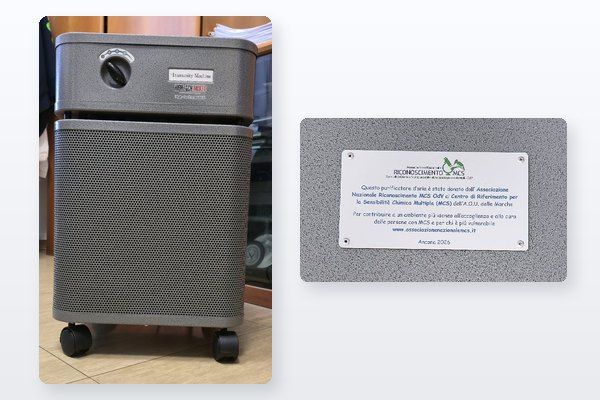 An air purifier donated to the MCS Reference Center in Ancona: a project made possible by the 5x1000Read more: An air purifier donated to the MCS Reference Center in Ancona: a project made possible by the 5x1000
The National Association for the Recognition of MCS donated an Austin Air Immunity Machine® air purifier to the MCS...
-
 Dog and cat odors at home: how to get rid of litter box ammonia tooRead more: Dog and cat odors at home: how to get rid of litter box ammonia too
The ammonia smell of the litter box, a wet dog's coat, hair and allergens everywhere: anyone living with dogs and...
Blog categories
Search in blog

Microplastics and nanoplastics in indoor air: what they are, how many we breathe and how to reduce them
Microplastics are not only in the sea and in food: they are also in the air we breathe at home, in far higher amounts than previously thought. What they are, where they come from, what research shows and how to reduce them.
Updated: • Reading: ~8 min
What microplastics and nanoplastics are
Microplastics are plastic fragments smaller than 5 millimetres. Nanoplastics are even smaller: the term usually refers to particles below 1 micrometre (µm), invisible to the naked eye and comparable in size to the finest dust.
They mostly come from the slow breakdown of larger items: textiles, packaging, furniture, tyres. At home they are constantly shed by the synthetic materials we use every day, stay suspended in the air and settle in dust, from which they return to the air whenever we move.
Where they come from at home
Synthetic textiles
Polyester, nylon and acrylic release microfibres when we wear, wash and dry them. Clothes, blankets and curtains are among the main sources.
Rugs and carpets
Synthetic fibres wear down underfoot and release particles that end up in dust and in the air.
Sofas and upholstery
Synthetic covers and padding slowly break down with use, especially when they are old.
Packaging and plastic items
Films, containers and everyday objects degrade with time, heat and light, and release fragments.
Household dust
It is the main reservoir of microplastics at home: it settles on floors and surfaces and returns to the air when we walk, sweep or make the bed.
Car interiors
Seats, plastics and mats in a small, closed space: the study below found even higher concentrations in cars than at home.
How many we really breathe
In 2025 a team of researchers at the University of Toulouse measured the smallest microplastics suspended in the air of apartments and cars, using a technique (Raman spectroscopy) able to detect particles down to 1 µm. The results, published in PLOS One, show that indoor air is a so far heavily underestimated exposure route.
528 particles/m³ at home · 2,238 particles/m³ in cars · 94% below 10 µm · 68,000 inhaled per day (1-10 µm)
Source: Yakovenko et al., PLOS One, 2025 (median values).
The most striking figure is size: over 90% of the particles found were smaller than 10 µm, small enough to reach deep into the lungs. Combining their measurements with previous studies, the authors estimate that an adult inhales about 68,000 a day in the 1-10 µm range, a hundred times more than earlier estimates, plus about 3,200 between 10 and 300 µm.
It is a small study (16 air samples), and values vary widely from one environment to another. But the message is clear: at home and in the car we breathe far more microplastics than was believed.
What research says about health
The health effects of microplastics are still being studied, but research has multiplied in recent years. Microplastics have been found in the lungs, in the blood and in other organs; a 2024 study in JAMA Network Open detected them in the olfactory bulb, the part of the brain linked to smell, in 8 of the 15 people examined.
The Italian study in the New England Journal of Medicine
One of the most cited studies in the world is Italian. In 2024 researchers at the University of Campania Luigi Vanvitelli analysed plaques removed from the carotid arteries of 257 patients: 58.4% contained polyethylene, and about 12% also PVC. Followed for 34 months, patients with micro- and nanoplastics in their plaques had an at least doubled risk of heart attack, stroke or death compared with the others.
The authors themselves stress that the study shows an association, not proof that microplastics cause these events: research is continuing precisely to find out. But it is one of the strongest signals that reducing exposure, where possible, is a common-sense choice.
How to reduce microplastics at home
Choose natural fabrics
Cotton, linen and wool for sheets, blankets and curtains, especially in the bedroom, where you spend the most hours.
Vacuum with a HEPA filter
A vacuum without a HEPA filter puts the finest particles back into the air; with HEPA they stay in the filter.
Dust with a damp cloth
A dry cloth or feather duster lifts dust; a damp one traps it.
Air rooms at the right time
Ventilate when outdoor air is good, avoiding heavy traffic hours.
Filter the air where you live
An air purifier with a HEPA filter in the bedroom and living room captures the particles that stay suspended.
Remember food and water
Air is one exposure route, not the only one: avoiding heating food in plastic containers helps reduce the others.
Can an air purifier capture microplastics?
Yes, if it has a quality HEPA filter: to the filter, microplastics are particles like any other, and they are captured just like dust, pollen and PM2.5. An independent 2024 study in university offices in Kuala Lumpur, published in E3S Web of Conferences, measured an average 35% drop in microplastics with air purifiers running, regardless of the offices' ventilation system.
The medical-grade HEPA filter in Austin Air purifiers, made with Hollingsworth & Vose media, captures 99.97% of particles at 0.3 µm and 99% at 0.1 µm, including, according to Austin Air, microplastics. The smallest nanoplastics are still little studied and there are no specific measurements for them for any home air purifier, but a filter that is efficient down to 0.1 µm covers most of the particles we breathe.
How you use it matters too: microplastics are shed continuously,so the purifier works best when it runs continuously in the rooms where you spend the most time: during the day at the speed suited to the room, at night at the quieter low speed. To choose the right size, use the air changes calculator.

The everyday model, for spaces up to 80 m²: 5.6 m² of medical-grade HEPA and up to 6.8 kg of non-impregnated activated carbon and zeolite.

Designed for the bedroom, where sheets, blankets and mattresses shed fibres all night. At low speed it measures 40 dB(A) at 1 m.

The most complete filtration in the range, with 8 stages: Austin Air explicitly lists microplastics among what it captures.
To compare all models, use the buying guide or the comparison page.
Frequently asked questions
Does an air purifier remove microplastics?
It traps them in the filter, if it has a quality HEPA: airborne microplastics are captured like other fine particles. It cannot remove those already settled in dust, so it is best combined with a HEPA vacuum and cleaning with a damp cloth.
Do nanoplastics pass through a HEPA filter?
The HEPA filter in Austin Air purifiers captures 99% of particles at 0.1 µm. There are no specific measurements yet for the smallest nanoplastics for any home air purifier, but a filter that is efficient down to 0.1 µm covers most of the particles in indoor air.
Where should I put the purifier?
In the rooms where you spend the most hours, first of all the bedroom, at least 10 cm from the walls. If you have only one purifier, keep it in the bedroom at night.
Are there more microplastics indoors or outdoors?
Indoors the sources are close and the air is changed less often, so particles build up. The Toulouse study found concentrations in apartments far higher than earlier estimates, and even higher in cars.
 Contact us
 WhatsApp (chat only)
Useful links
- HEPA air purifier: how it works and how to choose one
- Air purifier for allergies and asthma
- Urban air pollution and traffic
- The launch of the Immunity Machine
- Austin Air purifier buying guide
- Air changes calculator
- All Austin Air purifiers
Note: air purifiers are not medical devices and do not replace medical advice. Performance may vary depending on use, environment and maintenance.
Sources: Yakovenko N. et al., "Human exposure to PM10 microplastics in indoor air", PLOS One 20(7): e0328011, 2025; Marfella R. et al., "Microplastics and Nanoplastics in Atheromas and Cardiovascular Events", New England Journal of Medicine 390: 900-910, 2024; Amato-Lourenço L.F. et al., "Microplastics in the Olfactory Bulb of the Human Brain", JAMA Network Open, 2024; Dewika M. et al., "Identification and Mitigation of Deposited Indoor Air Microplastics in an Office Environment in Kuala Lumpur", E3S Web of Conferences 589, 2024; Austin Air Systems, Immunity Machine spec sheet.
Posted in:
Air Quality Blog
Related posts
-
 Asthma and Indoor Air Quality: What Science Says and How to Protect Yourself
Asthma affects over 3 million people in Italy and often worsens at night, when exposure to bedroom allergens is...Read more
-
 Ten independent clinical trials on Austin Air: what they show
Eight published studies and two in progress, conducted by eight independent research institutions on asthma,...Read more
-
 HEPA air purifier: how it works, what it is for and how to choose one
What a HEPA air purifier is, what it is for and how it works, how to choose one for your room and the most common...Read more
-
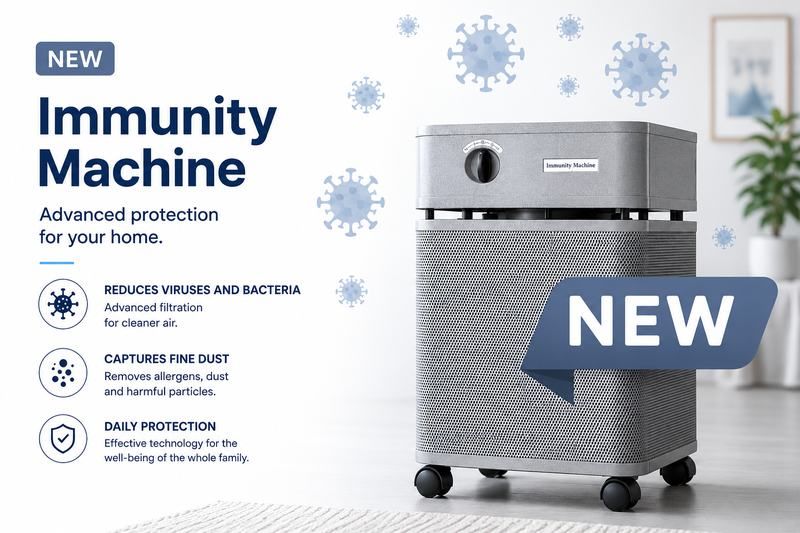 Austin Air announces the launch of the Immunity Machine, its most advanced air purifier.
Austin Air introduces the Immunity Machine, its most advanced air purifier: 8-phase filtration with medical-grade...Read more
-
 MCS and Air Purification: A Guide to More Livable Spaces
A practical guide to air purification for people with MCS and chemical sensitivity: how to choose the right purifier,...Read more
Leave a comment