In winter we spend almost all our time indoors with the windows closed. Ventilation removes CO₂ and humidity, while...

Latest posts
-
 Closed windows in winter: ventilation and air purifier, the right pair for your indoor airRead more: Closed windows in winter: ventilation and air purifier, the right pair for your indoor air
-
 Renovation and indoor air: dust, paint and VOCs, how to protect yourself during and after the workRead more: Renovation and indoor air: dust, paint and VOCs, how to protect yourself during and after the work
A renovation changes the air at home twice: during the work because of dust, afterwards because of VOCs from paint,...
-
 Gas stoves and indoor air: nitrogen dioxide, benzene and how to protect yourselfRead more: Gas stoves and indoor air: nitrogen dioxide, benzene and how to protect yourself
In Italy more than half of all homes cook with gas. Studies show that the flame releases nitrogen dioxide, benzene...
-
 Scented candles, incense and diffusers: what they release into your indoor airRead more: Scented candles, incense and diffusers: what they release into your indoor air
Candles, incense, wax melts and diffusers make the holiday atmosphere warmer, but they release particles,...
-
 Microplastics and nanoplastics in indoor air: what they are, how many we breathe and how to reduce themRead more: Microplastics and nanoplastics in indoor air: what they are, how many we breathe and how to reduce them
Microplastics are also in the air at home, far more than was thought. What micro- and nanoplastics are, where...
-
 HEGA cloth: what military-grade activated carbon does in Austin Air filtersRead more: HEGA cloth: what military-grade activated carbon does in Austin Air filters
HEGA cloth is the military-grade activated carbon in the Bedroom Machine and Immunity Machine filters. What it is,...
-
 A gift you can breathe: Austin Air ideas for your loved ones (and for you)Read more: A gift you can breathe: Austin Air ideas for your loved ones (and for you)
Some gifts end up in a drawer, others work every day, quietly, for many years. Here is which Austin Air purifier to...
-
 Coconut or coal-based carbon: which is better for VOCsRead more: Coconut or coal-based carbon: which is better for VOCs
Coconut shell or coal: two materials with different pores. Here is what the studies say and which works best with...
-
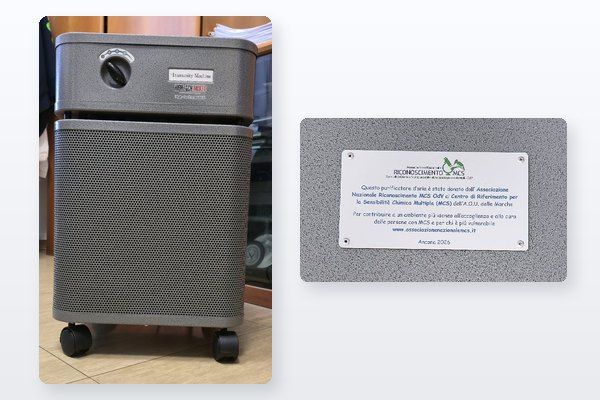 An air purifier donated to the MCS Reference Center in Ancona: a project made possible by the 5x1000Read more: An air purifier donated to the MCS Reference Center in Ancona: a project made possible by the 5x1000
The National Association for the Recognition of MCS donated an Austin Air Immunity Machine® air purifier to the MCS...
-
 Dog and cat odors at home: how to get rid of litter box ammonia tooRead more: Dog and cat odors at home: how to get rid of litter box ammonia too
The ammonia smell of the litter box, a wet dog's coat, hair and allergens everywhere: anyone living with dogs and...
Blog categories
Search in blog

Closed windows in winter: ventilation and air purifier, the right pair for your indoor air
In winter we spend almost all our time indoors, with the windows closed to keep the heat in. Everything we produce inside, by cooking, sleeping, lighting the fireplace or a candle, stays in the air we breathe.
The answer is not choosing between open and closed windows, but making ventilation and the air purifier work together: the first removes CO₂ and humidity, the second cleans the air of particles, smog, allergens and VOCs, 24 hours a day.
What builds up at home with the windows closed
CO₂
We produce it by breathing. In a closed room, especially at night and with several people, the concentration rises hour by hour.
Humidity
Cooking, showers, drying laundry and breathing add moisture. When it lingers, it encourages condensation and mould on walls and window frames.
Fine particles
From gas stoves, candles and incense, fireplaces and stoves: with the windows closed they stay indoors for longer.
VOCs and allergens
Furniture, cleaning products and air fresheners release VOCs; dust mites, dander and dust concentrate in poorly ventilated rooms.
Why ventilation matters, even in winter
CO₂ and humidity only go down when fresh air comes in. A series of studies by the Technical University of Denmark on bedroom ventilation shows this clearly:
- in Danish bedrooms, with the windows closed the average CO₂ during the night was about 1,820 ppm, compared with 761 ppm with the windows open, and sleep was shorter;
- in a study in Belgium, bedrooms with around 1,900 ppm of CO₂ had less deep sleep, more light sleep and more awakenings.
Humidity also needs to be kept under control: when it lingers, condensation forms on cold surfaces and, over time, mould.
How to ventilate properly in winter
The Swiss Federal Office of Public Health gives simple advice that works in every home:
Three times a day
Air the whole home in the morning, at midday and before going to bed, and busy rooms more often.
A few minutes are enough
At least 5 minutes during the heating season, 3 minutes on very cold or windy days.
Windows wide open
It is better to open them fully, creating a draught, than to keep them tilted for hours: far more heat is lost.
Bedrooms not too cold
Below 18 °C in bedrooms the risk of condensation on walls and window frames increases.
Right after cooking and showering
Steam and odours should be removed straight away, with the range hood or by opening the window, especially if you cook with gas.
New homes: more often
In new or renovated buildings it is worth ventilating more, especially in the first few weeks.
But in winter the outdoor air is not always clean
There is a problem that people in northern Italy know well: in winter the outdoor air is also often loaded with fine particles. According to Legambiente's Mal'Aria di città 2026 report, in 2025 13 provincial capitals exceeded the limit of 35 days a year above 50 µg/m³ of PM10.
66
days in Milan
48
days in Lodi and Monza
44
days in Cremona and Verona
Every time you open the windows, smog and fine particles come in along with the fresh air. So, when you can, avoid airing during traffic rush hours. We also cover this in our articles on air quality in Italy and traffic pollution.
Ventilation and air purifier: the right pair
Ventilation and the air purifier do two different jobs, and together they cover everything:
Ventilation
A few minutes, three times a day: it removes CO₂ and humidity and refreshes the air in the home.
The air purifier
It works 24 hours a day, in all the hours when the windows are closed, which is almost always: it captures particles, smog, allergens and VOCs, including those that came in from outside when you opened up.
- Particles and smog: the medical-grade HEPA filter in Austin Air purifiers captures 99.97% of particles at 0.3 µm and 99% at 0.1 µm (official Austin Air data).
- Gases, odours and VOCs: the bed of coconut shell activated carbon and zeolite, up to 6.8 kg in the standard models, adsorbs gases, odours and VOCs. Thanks to the 360° intake, air passes slowly through the carbon, with a longer contact time.
- Always on: Austin Air purifiers are designed to run 24 hours a day. At night, on low speed, they are quiet.
- The right size: multiply the room's m² by 5.4 to find the m³/h needed for two air changes per hour (2.7 m ceilings), or use our air changes calculator.
Which Austin Air model to choose

HealthMate
The choice for everyday use in the living room and in spaces up to 80 m²: medical-grade HEPA and up to 6.8 kg of non-impregnated activated carbon and zeolite.

HealthMate Plus
For those living in the city or near busy roads: the potassium iodide impregnated carbon is more effective on smog gases and VOCs.

Bedroom Machine
For the bedroom, where the windows stay closed all night: it adds HEGA carbon cloth, with no impregnated materials.

HealthMate Junior
For rooms up to 40 m², such as a child's bedroom or a study: the same construction as the larger models in a compact format.
Models with impregnated materials (HealthMate Plus and Immunity Machine) are also used regularly by a growing number of people with MCS. For those who prefer non-impregnated materials, the alternatives are the HealthMate, Bedroom Machine and HealthMate Junior.
Frequently asked questions
Does the air purifier lower CO₂?
CO₂ goes down with ventilation, which is why a few minutes of open windows three times a day is enough. The air purifier works on everything else: fine particles, smog, allergens, odours and VOCs, in all the hours when the windows stay closed.
Can I keep the air purifier on while I air the room?
Yes, in fact it helps: while the windows are open, the air purifier filters the air coming in from outside, with the fine particles it carries in winter. There is no need to switch it off and on again.
Is it better to keep the windows tilted all day?
No. Tilted windows lose a lot of heat and refresh little air. A few minutes with the windows wide open, three times a day, with the air purifier always on, works far better.
Useful links
- Air changes calculator
- Air quality in Italy 2026: what is really happening
- Urban pollution and traffic: what we really breathe in cities
- Mold at home: types, health risks and how to protect the air you breathe
- Air purifier for allergies and asthma: protecting the air in your bedroom
Sources
- Swiss Federal Office of Public Health (FOPH), Arieggiare e riscaldare correttamente (Italian version): bag.admin.ch
- Fan X., Bedroom ventilation and sleep quality, Technical University of Denmark, 2023: orbit.dtu.dk
- Legambiente, Mal'Aria di città 2026, 2025 data, as reported by GreenMe (in Italian): greenme.it
Want to know which model suits your rooms? Write to us, we reply 7 days a week.
 Contact us
 WhatsApp (chat only)
Note: this article is for information purposes only. Air purifiers are not medical devices and do not replace medical advice. Performance may vary depending on use, environment and maintenance.
Posted in:
Air Quality Blog
Related posts
-
 Asthma and Indoor Air Quality: What Science Says and How to Protect Yourself
Asthma affects over 3 million people in Italy and often worsens at night, when exposure to bedroom allergens is...Read more
-
 Ten independent clinical trials on Austin Air: what they show
Eight published studies and two in progress, conducted by eight independent research institutions on asthma,...Read more
-
 HEPA air purifier: how it works, what it is for and how to choose one
What a HEPA air purifier is, what it is for and how it works, how to choose one for your room and the most common...Read more
-
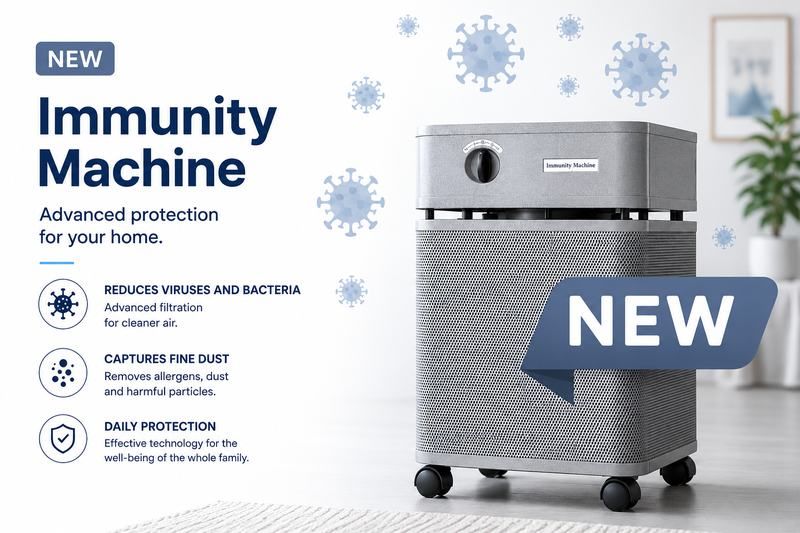 Austin Air announces the launch of the Immunity Machine, its most advanced air purifier.
Austin Air introduces the Immunity Machine, its most advanced air purifier: 8-phase filtration with medical-grade...Read more
-
 MCS and Air Purification: A Guide to More Livable Spaces
A practical guide to air purification for people with MCS and chemical sensitivity: how to choose the right purifier,...Read more
Leave a comment