Coconut shell or coal: two materials with different pores. Here is what the studies say and which works best with...

Latest posts
-
 Coconut or coal-based carbon: which is better for VOCsRead more: Coconut or coal-based carbon: which is better for VOCs
-
 An air purifier donated to the MCS Reference Center in Ancona: a project made possible by the 5x1000Read more: An air purifier donated to the MCS Reference Center in Ancona: a project made possible by the 5x1000
The National Association for the Recognition of MCS donated an Austin Air Immunity Machine® air purifier to the MCS...
-
 Dog and cat odors at home: how to get rid of litter box ammonia tooRead more: Dog and cat odors at home: how to get rid of litter box ammonia too
The ammonia smell of the litter box, a wet dog's coat, hair and allergens everywhere: anyone living with dogs and...
-
 Saharan dust and Etna ash: what they are and how to protect the air at homeRead more: Saharan dust and Etna ash: what they are and how to protect the air at home
Yellow skies from African dust and falls of Etna ash: two increasingly frequent natural phenomena that bring fine...
-
 Floods and indoor air: what happens afterwards and how to protect yourselfRead more: Floods and indoor air: what happens afterwards and how to protect yourself
After a flood, the air problem does not end when the water recedes: mold, bacteria, dust and odors can linger at home...
-
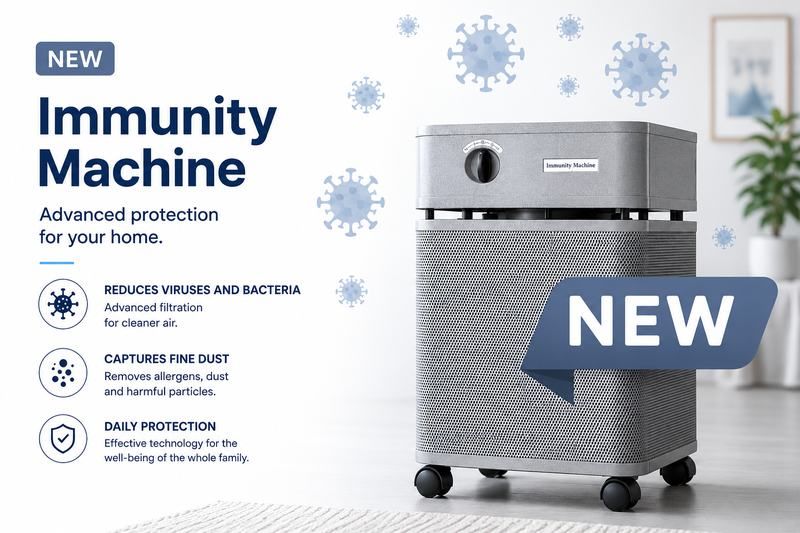 Austin Air announces the launch of the Immunity Machine, its most advanced air purifier.Read more: Austin Air announces the launch of the Immunity Machine, its most advanced air purifier.
Austin Air introduces the Immunity Machine, its most advanced air purifier: 8-phase filtration with medical-grade...
-
 MCS and Air Purification: A Guide to More Livable SpacesRead more: MCS and Air Purification: A Guide to More Livable Spaces
A practical guide to air purification for people with MCS and chemical sensitivity: how to choose the right purifier,...
-
 Air Purifiers: Complete Guide and How to Choose the Right OneRead more: Air Purifiers: Complete Guide and How to Choose the Right One
How to choose the right air purifier: HEPA and carbon filters, sizing, noise, running costs and maintenance....
-
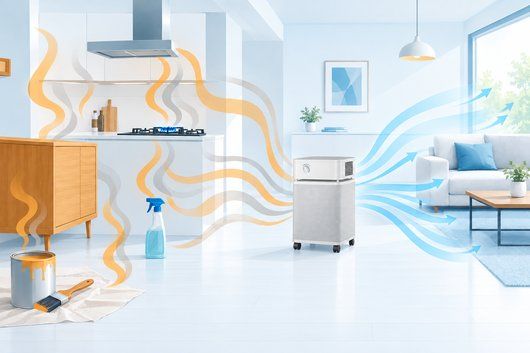 VOCs at home: what they are, where they hide and how to really remove themRead more: VOCs at home: what they are, where they hide and how to really remove them
Paint, new furniture, cleaning products and gas stoves release VOCs that no HEPA filter can stop. Discover where they...
-
 Extreme heat and air quality: what changes and how to protect yourselfRead more: Extreme heat and air quality: what changes and how to protect yourself
Extreme heat worsens the air quality we breathe, affecting everyone and especially people with MCS. Causes, updated...
Blog categories
Search in blog
Chemical Disasters and Indoor Air Quality: Is Your Home Safe?
Chemical incidents, industrial fires, toxic releases: why the air quality at home matters even in emergencies, and how a high-capacity purifier can make the difference.
Updated: • Reading: ~10 min
Air purification is essential in emergencies
When we talk about air pollution, we often think only of city smog or traffic. But there is another category of risk, less visible and just as serious: chemical disasters.
A chemical incident is the release of toxic substances into the environment that can harm public health. It can happen accidentally, as a consequence of a natural event or, in the most serious cases, deliberately.
The types of incident are many: industrial explosions, factory emissions, oil spills, fires, natural disasters, rail derailments with the loss of hazardous cargo. Every time they happen, we are potentially exposed to dangerous chemicals.
Italy is not immune: from the Po Valley to industrial incidents
Those living in Italy, especially in the north, know all too well an air quality that is often problematic. The Po Valley is one of the areas with the highest PM2.5 and PM10 levels in Europe, due to the geography that traps pollutants and to the strong industrial presence.
But the problem goes beyond chronic pollution. Over the years Italy has experienced acute episodes of chemical contamination: the Seveso incident in 1976 (release of TCDD dioxin, one of the most serious chemical disasters in European history), the fire at the special-waste depot in Pomezia in 2017 and the more recent fire at the waste-disposal plant in Coriano in 2022. Episodes that forced thousands of people to keep windows and doors shut for days.
The question few ask is: is the air we breathe at home really safe in those moments?
The danger does not end when the emergency is declared over
One of the most common mistakes is to believe that, once the incident is over, the risk has disappeared. In reality, chemicals persist far longer than people imagine. They settle and remain hidden in:
- Ventilation ducts and HVAC systems
- Curtains, rugs, sofas and upholstered furniture
- Horizontal surfaces (shelves, worktops, floors)
- Household water: volatile compounds can be inhaled even during everyday use (showering, running taps)
When you clean, dust or move something contaminated, the particles and chemicals return into circulation in the air we breathe. The risk of exposure does not stop when the emergency ends.
What an Austin Air purifier can do for you
Austin Air has decades of experience supporting environmental emergencies. The company has worked with FEMA and the American Red Cross during some of the worst disasters in recent US history: 11 September 2001, hurricanes Katrina and Sandy, the major California gas leak of 2015. Its purifiers have also been used for decades in remediation after wildfires.
In 2000, in independent tests conducted by Battelle Laboratories (Aberdeen, Maryland, for the U.S. Army Corps of Engineers), the Austin Air HealthMate was tested alongside over 100 other purifiers and selected as the best for chemical and VOC filtration.
 Why choose the Austin Air Immunity Machine®

Among the models in the range, the Immunity Machine® offers particularly complete protection, acting on all three fronts of chemical risk:
 Fine particulate (PM)
Explosions, fires and industrial releases disperse toxic debris and fine particulate (PM2.5 and PM10). The Immunity Machine uses 60 square feet (about 5.6 m²) of medical-grade HEPA, which removes 99.97% of particles down to 0.3 microns and 99% down to 0.1 microns, including the finest particulate.
 Chemicals, gases and VOCs
For chemical risk you need far more activated carbon than average. The Immunity Machine contains up to 6.8 kg of a blend of activated carbons and zeolite, including potassium iodide-impregnated carbon, to capture a wide range of gases, chemicals and VOCs.
Military HEGA filtration
A carbon cloth developed by the British Armed Forces in the 1970s against chemical and biological warfare, still used in military clothing and masks against CBRN agents (chemical, biological, radioactive and nuclear).
A single gram of HEGA cloth offers an enormous adsorption surface, equivalent to about half an American football field. Austin Air describes it as a technology unique to its purifiers and is the only manufacturer to integrate it into a portable home air purifier.
How does Austin Air compare with other brands?
In a chemical emergency, not all purifiers are equal. Austin Air stands out on three concrete aspects:
- HEGA filtration: the military-grade carbon cloth is the distinctive feature that Austin Air describes as unique to its portable home purifiers.
- Amount of HEPA: according to a US EPA report, purifiers must use sufficient amounts of HEPA and carbon, otherwise the filters run out within a few months. Austin Air uses 60 square feet of medical-grade HEPA.
- Activated carbon: many competitors use a simple carbon screen (1-2 kg of material); even with quality granular carbon, they rarely exceed 2-3 kg. Austin Air uses up to 6.8 kg.
Activated carbon: up to 6.8 kg in the Austin Air blend, compared with the typical 1-3 kg of the competition.
The health risks of chemical exposure
Exposure to chemicals after an environmental incident can cause very different effects depending on the type of substance, the duration and the intensity of contact. The risks are higher for children, the elderly and people with pre-existing conditions such as asthma, allergies or COPD. The effects can be:
- Local: irritation of the eyes, airways or skin at the point of contact
- Systemic: involvement of internal organs and body systems
- Psychological: anxiety, post-traumatic stress and other mental health effects
The timing also varies greatly: some symptoms appear within minutes or hours (respiratory irritation, dizziness, nausea), others, such as certain cancers or congenital malformations, may appear months or years after exposure.
As environmental medicine experts point out, including Dr Anne Marie Fine (Environmental Medicine Education International), chronic exposure to the toxic substances present in the environment is considered a significant factor in the rise of chronic diseases.
Conclusion: protecting your family starts with the air at home
In a world where chemical incidents seem increasingly frequent, and in a territory like the Po Valley where air quality is already a daily challenge, having a serious purification system is not a luxury but a conscious health choice.
The Austin Air Immunity Machine® combines medical-grade HEPA, a large amount of activated carbon and military HEGA filtration in a single compact, quiet device designed to last.
If you are not sure which model to choose, our complete guide to air purifiers can help you find your way.
Discover the Austin Air Immunity Machine® on high-techmarket.it, authorized Austin Air importer for Italy.
Useful links
- Austin Air Immunity Machine® product page
 Purifier buying guide
 Air quality in Italy 2026
- Wildfires and air quality
- Asthma and air quality: the clinical studies
 Compare the Austin Air models
 All Austin Air purifiers
 Contact us
Note: air purifiers are not medical devices and do not replace safety equipment, evacuation procedures or the instructions of the authorities in a chemical emergency. Performance may vary depending on use, environment and the substances present.
Sources: World Health Organization, Chemical Incidents; research on inhalation exposure to volatile substances in drinking water; Austin Air Systems, Battelle Laboratories test (Aberdeen, 2000).
Posted in:
Air Quality Blog
Related posts
-
 Asthma and Indoor Air Quality: What Science Says and How to Protect Yourself
Asthma affects over 3 million people in Italy and often worsens at night, when exposure to bedroom allergens is...Read more
-
 Ten independent clinical trials on Austin Air: what they show
Eight published studies and two in progress, conducted by eight independent research institutions on asthma,...Read more
-
Air Purifiers: Complete Guide and How to Choose the Right One
How to choose the right air purifier: HEPA and carbon filters, sizing, noise, running costs and maintenance....Read more
-
Austin Air announces the launch of the Immunity Machine, its most advanced air purifier.
Austin Air introduces the Immunity Machine, its most advanced air purifier: 8-phase filtration with medical-grade...Read more
-
MCS and Air Purification: A Guide to More Livable Spaces
A practical guide to air purification for people with MCS and chemical sensitivity: how to choose the right purifier,...Read more
Leave a comment