
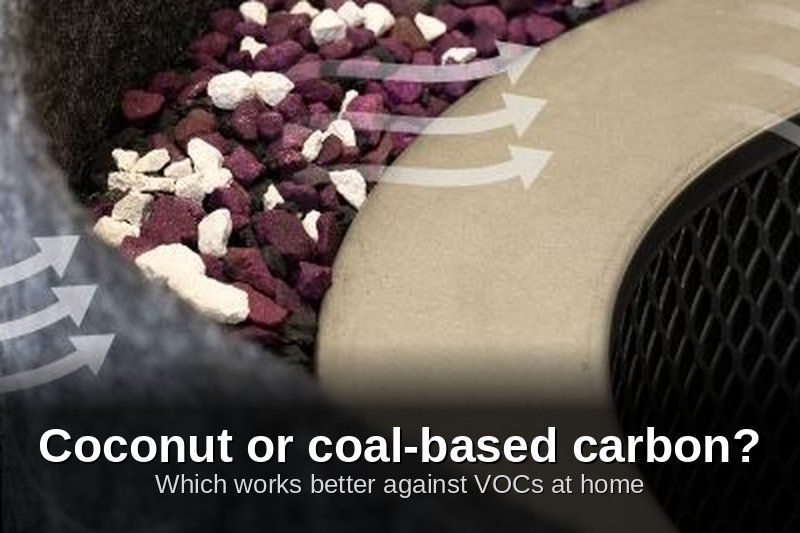
Coconut shell or coal: two materials with different pores. Here is what the studies say and which works best with...
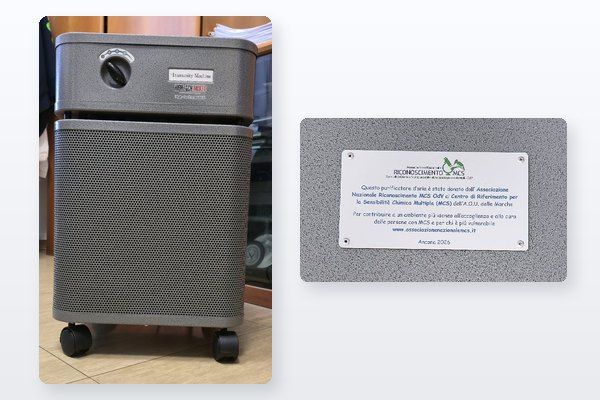


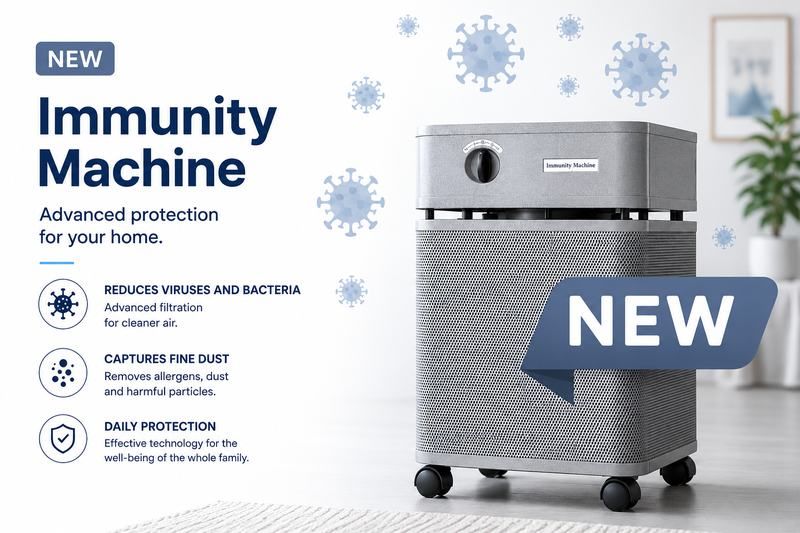


Ten reasons based on verifiable data: build quality, filter media, independent testing, and clinical trials.
Updated: • Read time: ~9 min
Not all air purifiers are the same
The air purifier market is crowded with products promising clean air, better health, and miracle filters. But once you look past the marketing and examine the actual data (independent testing, clinical trials, materials, construction), a clear gap emerges between most consumer purifiers and what Austin Air offers.
Austin Air Systems is not a company born out of a wellness trend. It was founded in 1990 in Buffalo, New York, and for more than thirty-five years it has been building medical-grade air purifiers for hospitals, government agencies, families, and people with the most critical respiratory needs. Sold in more than 100 countries, Austin Air purifiers are the result of decades of engineering, clinical research, and non-negotiable design choices.
5.6 m²
of medical-grade HEPA in standard models
6.8 kg
of activated carbon and zeolite per filter
8
published clinical trials, all positive
35+
years of manufacturing in the United States
1. Handcrafted in the United States
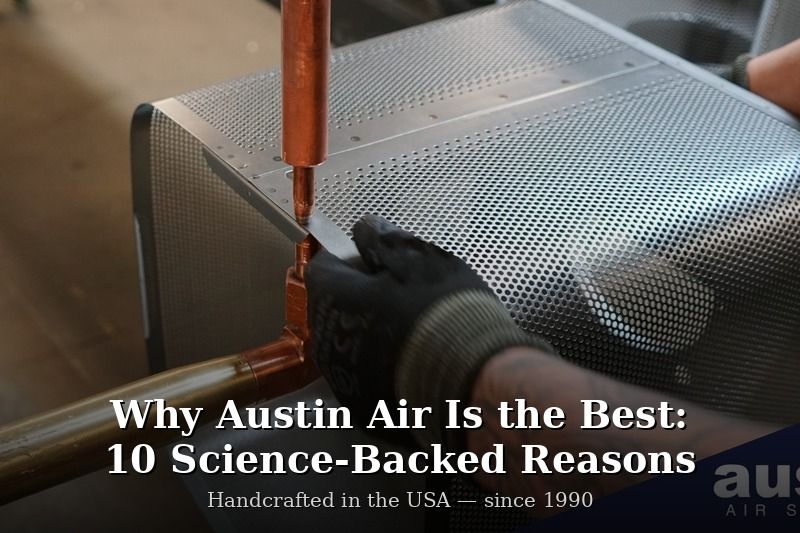
Every Austin Air purifier is assembled by hand in the largest air cleaner manufacturing facility in the world, located in Buffalo, New York: a plant of 480,000 square feet, about 44,600 m², entirely dedicated to quality.
This is not a minor detail. It means direct control over every stage of production, materials chosen without compromise, and a level of accountability that no manufacturer outsourcing production can guarantee in the same way.
2. Powder-coated steel, no VOC emissions
The housing of every Austin Air purifier is made of steel with a high-temperature baked powder coating. Not plastic, not composite materials, not synthetic resins.
The reason is technical and fundamental: plastics and many liquid paints release volatile organic compounds (VOCs) into the air, exactly the substances an air purifier is supposed to reduce. Austin Air chose steel and powder coating precisely so the device never contributes to polluting the air it is cleaning.
The internal motor is also unpainted, for the same reason. A choice that makes a real difference especially for people with Multiple Chemical Sensitivity (MCS).
3. Medical-grade HEPA filters, 5.6 m² of filter surface
The word "HEPA" is used indiscriminately across the industry. But there is a substantial difference between a consumer HEPA filter and a medical-grade one.
Austin Air uses 5.6 m² of medical-grade HEPA in standard models and 2.8 m² in Junior models, with Hollingsworth andamp; Vose filter media (HC-4011 grade), capable of capturing:
99.97% of airborne particles down to 0.3 microns
99% of airborne particles down to 0.1 microns, sub-micron sizes that many consumer HEPA filters do not reach
The filter surface area is far greater than that of most competitors in the same range. More HEPA surface means more capacity, longer life, and less pressure drop over time.
4. Up to 6.8 kg of activated carbon and zeolite
The HEPA filter captures particles, but gases, VOCs, chemicals, and odors require activated carbon, and here the difference from competitors is marked.
Many consumer purifiers contain 100-200 grams of activated carbon, often as a thin granular screen. Austin Air uses up to 6.8 kg (15 lb) of an activated carbon and zeolite blend in every standard-size filter, and up to 2.7 kg (6 lb) in Junior models.
The carbon is coconut shell carbon, rich in micropores, the best suited to trapping VOCs at the low concentrations typical of indoor air. Thanks to the 360° intake, air passes slowly through the layer of carbon surrounding the HEPA, with a longer contact time that favours the adsorption of gases and odors.
An important clarification: all standard models contain the same amount of carbon and zeolite. The difference between models is not the quantity but the type: in the HealthMate Plus, the Plus Junior, and the Immunity Machine the carbon is impregnated with potassium iodide, which increases capacity on formaldehyde and volatile chemical compounds. In the HealthMate, the HealthMate Junior, and the Bedroom Machine, carbon and zeolite are not impregnated.
This quantity is not a technical detail: it is the difference between a filter that saturates in a few months and one that retains capacity for years.
5. The HEGA filter, military-origin technology
HEGA (High Efficiency Gas Adsorption) cloth is a woven activated carbon fabric, developed in a British military context as protection against chemical and biological agents. It is still used today in military clothing and masks against CBRN agents (chemical, biological, radiological, and nuclear).
According to the manufacturer, one square inch of HEGA cloth (about 6.5 cm²) provides an adsorption surface area equivalent to a football field. Austin Air states that it is the only manufacturer integrating this material into a domestic air purifier.
HEGA is featured in the Bedroom Machine (fifth stage) and the Immunity Machine (eighth stage), the models designed for those with higher demands: people with chemical sensitivity, people with heightened immune vulnerability or particular respiratory needs.
6. Filters designed to last up to 5 years
Most consumer purifiers require a filter change every 3-6 months. Austin Air filters are designed for an expected life of up to about 5 years under normal residential conditions.
This is not marketing: it is a direct consequence of the amount of filter media used. 5.6 m² of HEPA and up to 6.8 kg of carbon and zeolite have far greater adsorption capacity than standard filters, and do not saturate within months.
Do not confuse lifespan with warranty: the 5 years are an expected lifespan, not a warranty period. Actual life depends on pollution levels and intensity of use, and may be shorter in heavily contaminated environments. Filters are consumables subject to saturation and are not covered by the warranty.
Over the long term, the cost per year of an Austin Air filter is often lower than that of seemingly cheaper purifiers requiring frequent replacements. To find out which filter your model needs, see the replacement filters guide.
7. Tested by independent laboratories
Austin Air performance is not based on internal testing alone: it has been verified by third-party laboratories and agencies.
Battelle Laboratories
In 2000, in Aberdeen (Maryland), the HealthMate was tested alongside more than 100 other air purifiers and was selected as the top performer for chemical and VOC filtration.
AQMD
The South Coast Air Quality Management District, the Californian air quality authority, confirmed the effectiveness of Austin Air HEPA filtration.
CARB
California Air Resources Board certification confirms ozone emissions well below safety limits.
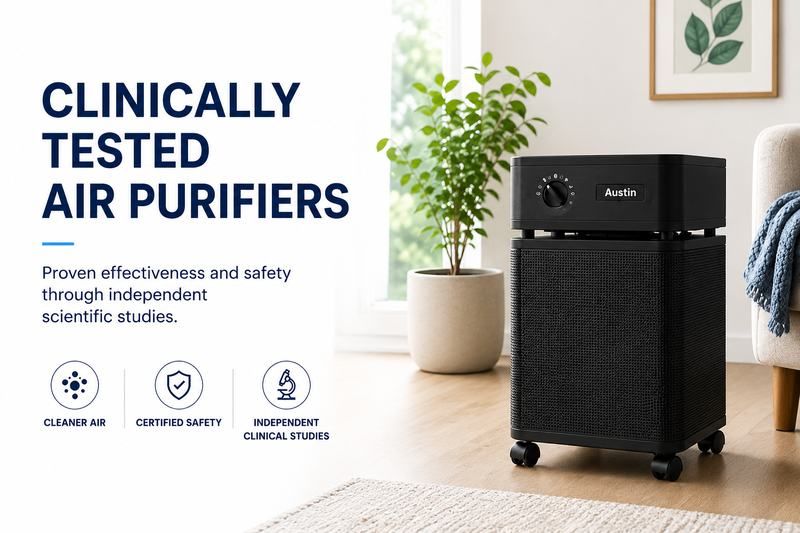
8. Ten clinical trials with eight research institutions
Austin Air states that it is the only air purifier manufacturer to have conducted clinical trials in direct collaboration with hospitals and research universities. Over more than 25 years, 10 independent clinical trials have been carried out with 8 different institutions: eight published, all with positive outcomes, and two still in progress.
Cincinnati Children’s Hospital 2001-2010
After 12 months of HealthMate use in the bedroom and living room, children’s asthma symptoms improved and unscheduled asthma-related medical visits fell by 18.5%.
Johns Hopkins University 2009-2015
Austin Air purifiers significantly reduced nitrogen dioxide (NO₂) in homes with gas cooktops, outperforming even the range hood.
Johns Hopkins University 2018
In homes with smokers, two Austin Air purifiers reduced PM2.5 and cotinine (a secondhand smoke marker) in non-smoking pregnant women.
University of Washington HAPI study, 2015-2020
In families with asthmatic children exposed to agricultural pollution: PM2.5 down 60% in the sleeping area and 42% in the living area, 65% fewer unplanned clinical visits.
Tufts University and Olin College 2021
First randomized trial to show that reducing traffic-related air pollution prevents acute increases in blood pressure. Published in Hypertension (American Heart Association).
Johns Hopkins University CLEAN AIR study, 2021-2022
In 116 former smokers with moderate to severe COPD, the HealthMate significantly reduced symptoms, exacerbations, and rescue medication use in a 6-month randomized trial.
University of Connecticut HAFTRAP study, 2026
In adults over 40 exposed to traffic, HEPA filtration led to a 12% improvement in the timing of a cognitive function test.
University of Massachusetts Lowell 2025
In 67 low-income households with gas cooktops, 12 months of monitoring showed NO₂ down 36% and PM2.5 down 45%.
Johns Hopkins University ongoing
Assessing the effects of HEPA filtration on particulate exposure in newborns and very young children.
Illinois Institute of Technology ongoing
With the Jesse Brown VA Medical Center, a one-year study on 80 veterans with moderate to severe COPD (protocol published in 2025).
A clinical track record of this breadth is rare in the industry: eight published studies, no negative results.
9. Chosen in emergency situations
The most concrete proof of a product’s reliability is not marketing: it is who chooses it when the situation is critical.
September 11, 2001
Austin Air was recommended by FEMA, the Red Cross, and the U.S. Department of Housing to protect residents from ash and VOCs.
Anniston, Alabama, 2002
The U.S. government distributed an Austin Air purifier to more than 28,000 households to protect them from a possible chemical weapons release.
Hurricanes and wildfires
Katrina, Sandy, the 2015 California gas leak, and wildfires: Austin Air is deployed whenever air quality becomes a public health emergency.
COVID-19 pandemic
More than 40,000 Austin Air purifiers supplied to Canadian schools, protecting around one million students and teachers.
10. Three-year warranty and individual checks in Italy
As authorized importers for Italy, we offer a 3-year warranty on mechanical and electrical components, in addition to the 24-month statutory warranty for consumers. Filters, with an expected life of up to 5 years, are consumables and are not covered by the warranty.
In addition, every purifier is individually checked in Italy before delivery: an extra inspection on top of the factory one, which lets us catch any transport damage before it reaches you.
When air quality matters, there is no room for compromise
The market is full of purifiers with a modern look, an accessible price, and ambitious promises. But when it comes to protecting health, your own or that of someone with a respiratory condition, promises are not enough.
Austin Air can rely on more than 35 years of American manufacturing, eight published clinical trials with positive results and two in progress, independent testing by laboratories and government agencies, military-origin filtration technology, and the trust of the main U.S. emergency agencies.
If you are unsure which model to choose, the buying guide, the comparison page, and the air exchange calculator can help.
 WhatsApp
Useful links
 Austin Air air purifier buying guide
 Austin Air replacement filters guide
 Austin Air model comparison
 Air exchange calculator
 Practical guide to air purifiers
 All Austin Air purifiers
- Replacement filters
 Contact us
Note: claims refer to independent studies and/or laboratory tests on the product and filter media, carried out mainly in the United States on specific populations and settings. Performance may vary depending on use conditions and maintenance. Air purifiers are not medical devices and do not replace preventive measures, diagnosis, or treatments recommended by your physician.
Sources:
(1) Austin Air Systems, About Us, austinairsystems.com
(2) Austin Air Systems, FAQ, austinairsystems.com/pages/faq
(3) Austin Air Systems, Clinical Trials, austinairsystems.com/pages/clinical-trials (full list of the 10 studies with DOIs and links to peer-reviewed publications)
(4) Battelle Laboratories, independent comparative testing, Aberdeen (MD), 2000
(5) EPA, Residential Air Cleaners: A Technical Summary, 3rd Edition
Leave a comment